
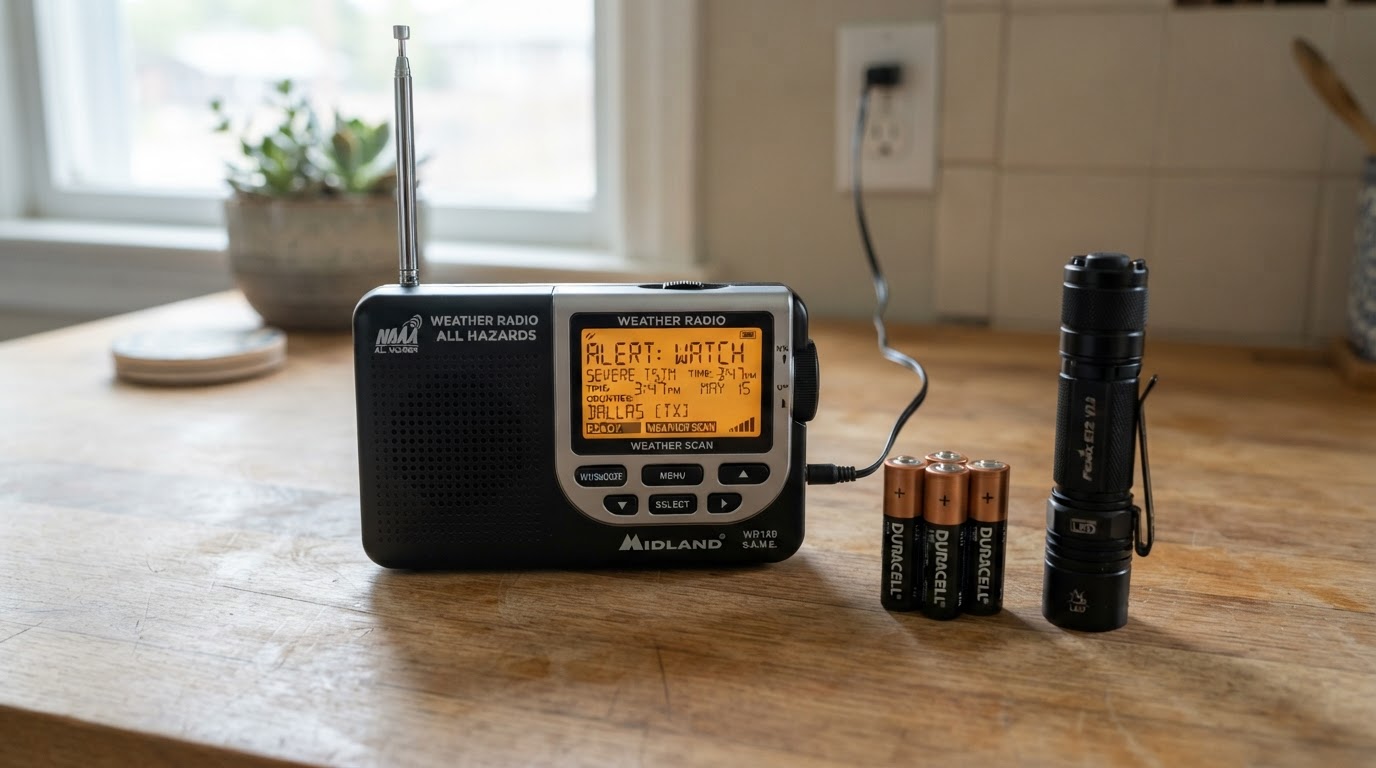
Best Emergency Radio
Best Emergency Radio: How to Choose a NOAA Weather Radio
An emergency radio keeps you informed when cell service and power fail. This guide explains how to compare weather radios by alert features, reception, and power options so you choose one that works when you need it most.
Quick Answer
The best emergency radio for most households is a NOAA weather radio with automatic alerts, S.A.M.E. county programming, battery backup, and a hand crank or solar panel for power when electricity is out. Receiving NOAA channels is not the same as receiving automatic alerts, so check that the radio supports S.A.M.E. alerts before buying. Keep extra batteries and practice using the radio before a disaster.
Key Takeaways
- •Choose a radio with automatic NOAA alerts and S.A.M.E. county programming.
- •Battery backup and a hand crank or solar panel keep the radio running without grid power.
- •Automatic alerts wake the radio and sound an alarm, unlike passive reception.
- •Practice programming and using the radio before you need it.
NOAA Reception Versus Automatic Alerts
Many radios can receive NOAA weather channels, but not all provide automatic alerts. A radio that merely receives channels requires you to tune in and listen. A radio with automatic alerts wakes itself, sounds an alarm, and broadcasts the warning so you hear it even while sleeping or away from the radio.
S.A.M.E. (Specific Area Message Encoding) technology lets you program the radio for your county, so it alerts only for warnings that affect your area rather than every warning in the broader broadcast range. Look for both automatic alerts and S.A.M.E. programming, not just NOAA reception.
Power Options That Matter
Grid power is often the first thing to fail in a disaster.
- •Battery backup: keeps the radio running when power goes out.
- •Hand crank: generates power without batteries, though effort is significant.
- •Solar panel: charges during daylight, useful for extended outages.
- •USB charging: convenient but relies on a charged power bank or station.
- •Keep spare batteries in the sizes the radio uses.
Reception and Antenna Considerations
NOAA weather radio reception depends on your location relative to the nearest transmitter. In valleys or remote areas, reception can be weak. A radio with a telescoping antenna or an external antenna jack can improve reception. Test the radio at home before relying on it.
If you live in a metal building or a basement apartment, reception may be poor. Try the radio near a window. Some radios accept an external antenna for better reception in difficult locations.
Features Worth Comparing
Compare the alert options, programming method, display, and power sources. A radio with a readable display, programmable alerts, and multiple power sources is more useful than a bare receiver. Public Alert certification indicates the radio meets NOAA standards for alert reception.
Avoid radios that look like emergency gear but lack the alert features you need. A flashlight and phone charger are useful extras, but the core function is receiving alerts. Prioritize the alert and reception features first.
Emergency Radio Feature Comparison
| Feature | Why it matters | Check before buying |
|---|---|---|
| Automatic alerts | Wakes the radio and sounds an alarm | Confirm alert support, not just reception |
| S.A.M.E. programming | Limits alerts to your county | Verify county programming is supported |
| Battery backup | Runs without grid power | Check battery type and availability |
| Hand crank or solar | Power when batteries run low | Test cranking effort and solar output |
| Public Alert certified | Meets NOAA alert standards | Look for the certification label |
Frequently Asked Questions
Does a NOAA weather radio automatically alert me?
Only if it supports automatic alerts. Some radios merely receive channels, so you must tune in and listen. Look for automatic alert and S.A.M.E. programming so the radio wakes and sounds an alarm for your county.
Will a hand crank radio power itself indefinitely?
A hand crank provides limited power with significant effort. It is a backup, not a primary source. Keep spare batteries and a power bank too. Cranking for a few minutes buys radio time, not hours.
Do I need S.A.M.E. programming?
It limits alerts to your county so you are not woken by warnings for distant areas. If your radio supports it, program your county code. Without it, the radio alerts for the entire broadcast range.
Will my weather radio work if I live in a valley?
Reception depends on proximity to a NOAA transmitter and terrain. Test the radio at home, preferably near a window. Some models accept an external antenna for better reception in difficult locations.