Power Outage Supplies
Power Outage Supplies: What to Buy for a Grid Failure
Power outage supplies are the items that keep your household safe and functional when electricity fails. This guide covers what to buy for light, backup power, food safety, and communication, organized by priority so you spend on what matters first.
Quick Answer
Power outage supplies are the items your household needs when electricity fails: flashlights and lanterns for light, a power bank or portable power station for devices, a NOAA weather radio for alerts, and supplies for food safety. The priority order is light, power for communication, food safety, and then comfort items. Never buy fuel generators without learning safe outdoor operation and carbon monoxide risks.
Key Takeaways
- •Light comes first: flashlights, lanterns, and headlamps with spare batteries.
- •A power bank or power station keeps phones and devices running.
- •A NOAA weather radio provides alerts when cell service fails.
- •Never use fuel generators, grills, or stoves indoors; carbon monoxide is deadly.
Lighting Supplies
Buy these first.
- •A room lantern for area lighting.
- •Flashlights for focused light, one per room minimum.
- •Headlamps for hands-free light, one per person if possible.
- •Spare batteries in the sizes your lights use.
- •A lantern with a low mode for long runtime.
Backup Power Supplies
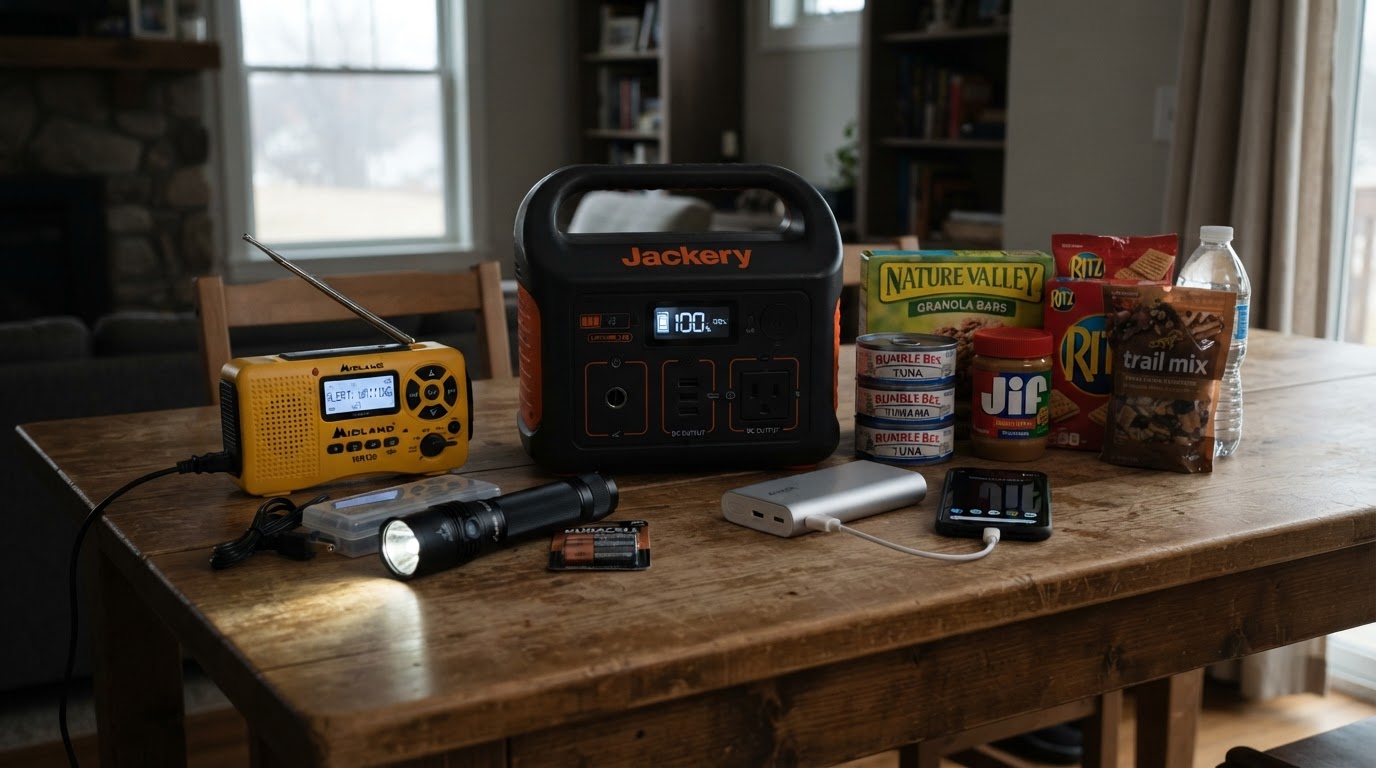
A power bank keeps a phone charged through a short outage. A 10,000 to 20,000 mAh bank charges a phone several times. For longer outages or more devices, a portable power station provides far more capacity and can run lights, a radio, or a small medical device.
If you use a power station, understand watt-hours versus watts. Watt-hours is capacity; watts is output. A 300 watt-hour station running a 30 watt device lasts about 10 hours. Check the output and ports match what you need to power.
Food Safety and Cooking Supplies
Keep a refrigerator thermometer so you know if food is safe. During an outage, keep doors closed and prioritize eating perishables first. Have shelf-stable food that needs no cooking as a backup.
If you use a camp stove for cooking, use it outdoors only. Carbon monoxide from fuel-burning appliances is deadly indoors. A portable power station can power an electric kettle or hot plate safely indoors, though it draws more power than a stove would.
Communication Supplies
A NOAA weather radio with battery backup and automatic alerts keeps you informed when phones and power fail. Keep spare batteries. Write down important contacts on paper so you are not dependent on a charged phone.
A power bank is part of communication, too. If your phone dies, you lose alerts, contacts, and the ability to call for help. Keep a charged power bank with your radio and flashlights.
Power Outage Supplies by Priority
| Priority | Supply | Purpose |
|---|---|---|
| 1 | Flashlights and lanterns | Light the first night and beyond |
| 2 | Power bank | Keep phones and radios running |
| 3 | Spare batteries | Extend light and radio runtime |
| 4 | NOAA weather radio | Receive alerts without power or cell service |
| 5 | Refrigerator thermometer | Know if food is safe |
| 6 | Portable power station | Power more devices for longer outages |
Frequently Asked Questions
What should I buy first for a power outage?
Light: flashlights, a lantern, and spare batteries. Then a power bank for your phone and a NOAA weather radio for alerts. These cover the most urgent needs at low cost.
Is a power bank enough for a long power outage?
A power bank handles a phone for a short outage. For a multi-day outage or multiple devices, a portable power station provides far more capacity. Match the power source to your needs and how long you want it to last.
Can I cook indoors during a power outage?
Use a camp stove or grill outdoors only. Fuel-burning appliances produce carbon monoxide, which is deadly indoors. A portable power station can safely power an electric kettle or hot plate indoors, but check the power draw first.
How do I know if my food is safe after a power outage?
Keep a thermometer in the refrigerator. If food has been above 40F (4C) for more than two hours, discard it. When in doubt, throw it out. Food poisoning during a disaster compounds the problem.