
Emergency Communication Plan
Emergency Communication Plan: Staying Connected During Disruptions
An emergency communication plan keeps your household connected when cell service and internet are down. This guide covers how to plan contacts, receive alerts, and choose backup communication methods.
Quick Answer
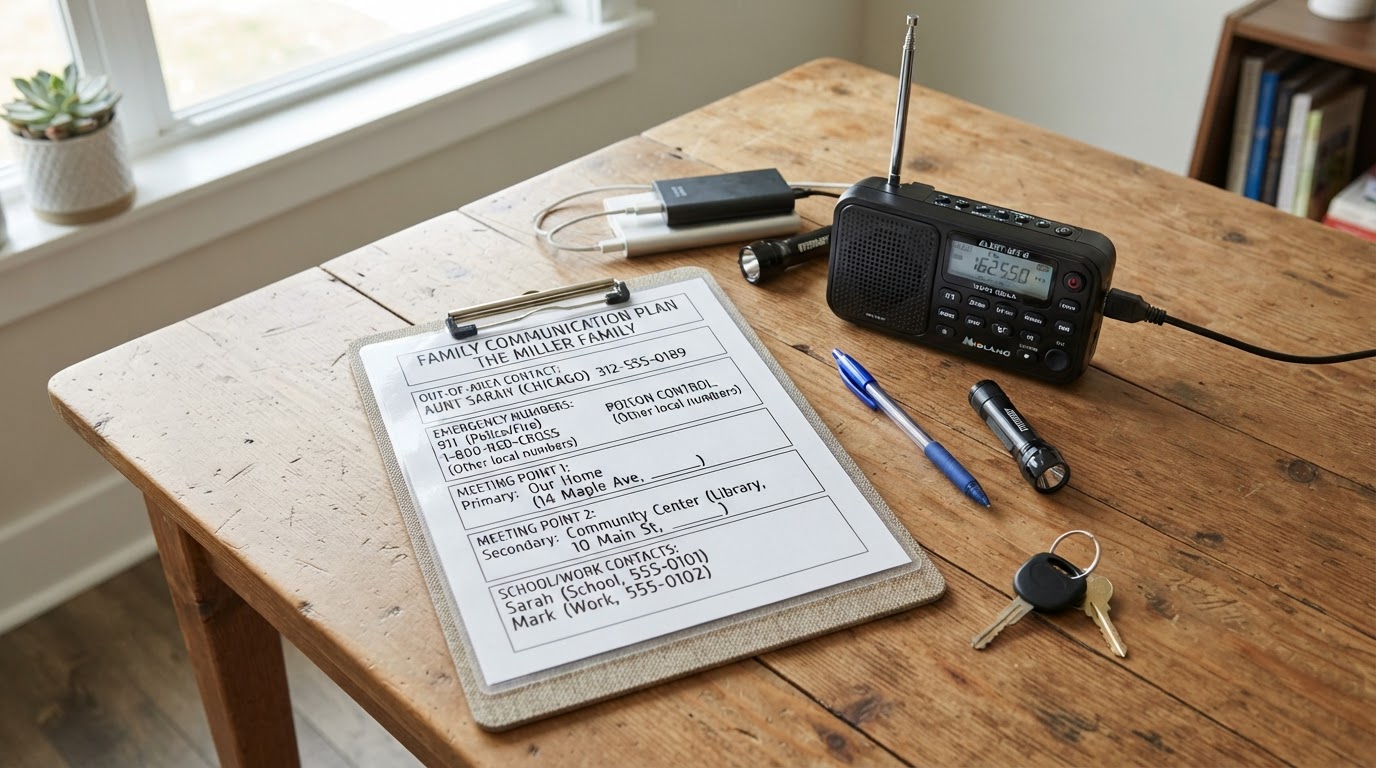
An emergency communication plan is a plan for how your household will contact each other and receive information during a disruption. It includes a written contact list, an out-of-area contact, a meeting point, a way to receive official alerts, and a backup communication method like a weather radio. Cell networks often fail in disasters, so plan for that.
Key Takeaways
- •Write down contacts; do not rely on your phone's memory.
- •Choose an out-of-area contact for relaying messages.
- •Plan a meeting point in case you are separated.
- •Keep a weather radio for alerts when cell service is down.
Why Cell Service Fails in Disasters
Cell networks depend on towers that need power and backhaul connections. In a disaster, towers lose power, connections break, and networks overload as everyone tries to call at once. Texts often get through when calls do not, because they use less bandwidth.
Plan for cell service to be down or unreliable. A written contact list, an out-of-area contact, and a weather radio keep you connected when phones fail.
Building Your Communication Plan
Include these in your plan.
- •A written contact list with phone numbers for family, work, and schools.
- •An out-of-area contact who can relay messages when local calls fail.
- •A meeting point near home and one outside your neighborhood.
- •A way to receive official alerts, such as a weather radio.
- •A backup power source for phones, such as a power bank.
- •A plan for how to reach children at school or family at work.
Receiving Official Alerts
Sign up for local emergency alerts on your phone. A NOAA weather radio with automatic alerts provides warnings when cell service is down, especially for weather hazards. Know the difference between a watch and a warning.
Keep a battery or hand-crank radio so you can receive alerts without grid power. Some radios can also charge a phone. A radio is one of the most reliable ways to receive official information during a widespread outage.
Backup Communication Methods
Beyond cell phones, consider a weather radio for alerts and a power bank to keep phones charged. For households that need more, a GMRS or amateur radio setup can provide longer-range communication, but these require licenses and training.
Satellite messengers can send texts and SOS signals from anywhere with a clear view of the sky, but they require a subscription. Choose the backup that fits your needs and budget.
Communication Methods by Situation
| Method | Best for | Limitation |
|---|---|---|
| Cell phone | Local calls and texts | Networks overload or lose power |
| Text message | When calls fail | Still needs a working tower |
| Weather radio | Receiving alerts | Receive only, needs batteries |
| Power bank | Keeping phones charged | Limited capacity |
| Satellite messenger | Remote areas | Subscription required |
Frequently Asked Questions
Why do I need an out-of-area contact?
Local calls often fail in a disaster because networks overload, but long-distance calls may still go through. An out-of-area contact can relay messages between family members who cannot reach each other directly.
Will my cell phone work during a disaster?
Maybe, but plan for it not to. Cell towers need power and can overload. Texts often work when calls do not. Keep a weather radio and a power bank as backups.
What is the best emergency radio?
A NOAA weather radio with automatic alerts and battery backup. Some include a hand crank or solar panel. Look for S.A.M.E. technology for county-specific alerts. See our weather radios gear guide for details.
How do I receive emergency alerts on my phone?
Sign up for your local emergency alert system, and enable Wireless Emergency Alerts in your phone settings. These are free and send warnings for imminent threats in your area.