
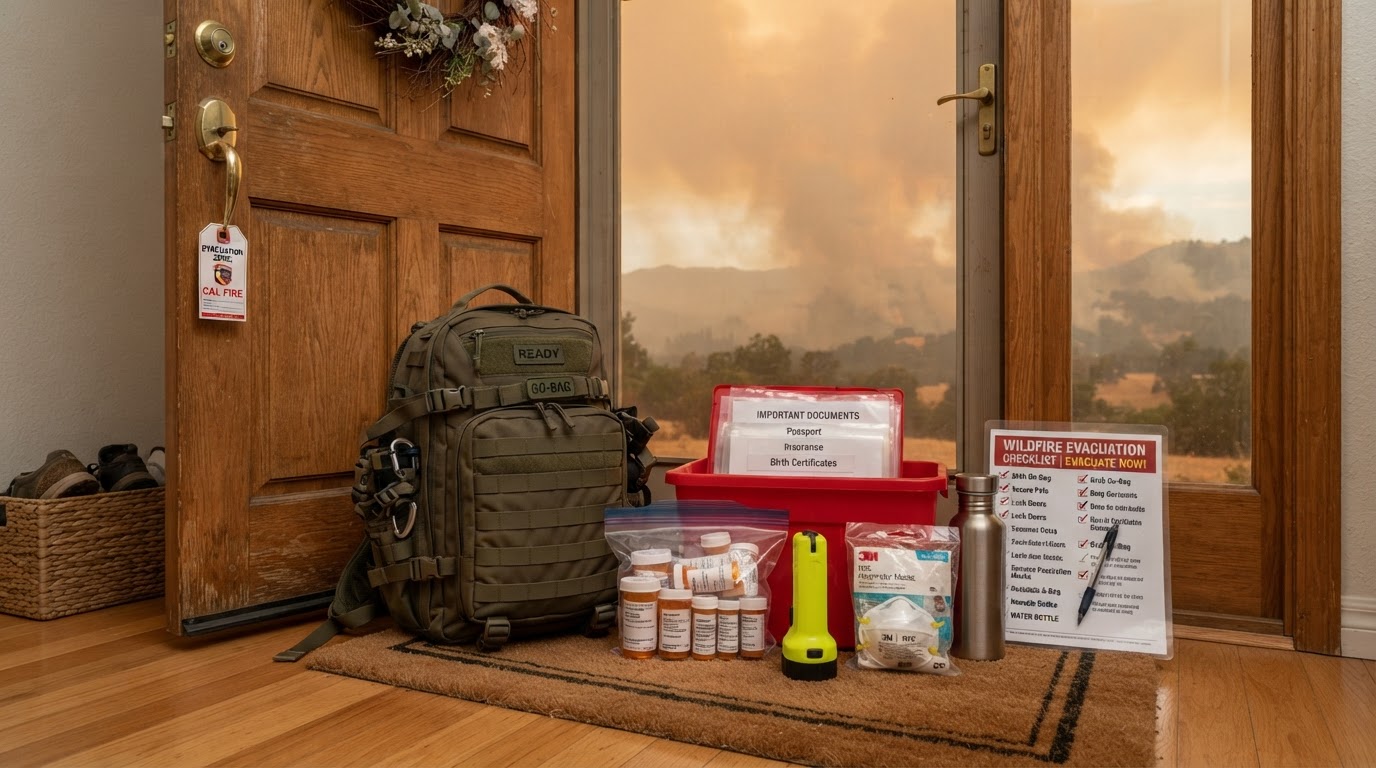
Wildfire Evacuation Checklist
Wildfire Evacuation Checklist: Prepare and Leave Fast
A wildfire evacuation checklist helps your household leave quickly and safely when a wildfire threatens. This guide covers what to prepare before fire season, what to do when an evacuation is ordered, and what to take with you.
Quick Answer
A wildfire evacuation checklist is a list of preparations and actions for leaving home safely during a wildfire. It includes creating defensible space, assembling a go-bag with documents and medications, planning evacuation routes, and leaving immediately when ordered. Wildfires move fast and conditions change rapidly, so prepare before fire season and leave early when an evacuation is ordered, not when flames are visible.
Key Takeaways
- •Create defensible space around your home before fire season.
- •Keep a go-bag packed with documents, medications, and supplies.
- •Plan at least two evacuation routes and a destination.
- •Leave immediately when an evacuation order is issued.
Before Fire Season: Prepare Your Home
Do this before wildfire season starts.
- •Create defensible space by clearing flammable vegetation near your home.
- •Move firewood and flammable materials at least 30 feet from structures.
- •Clean roofs and gutters of leaves and debris.
- •Use fire-resistant landscaping and materials where possible.
- •Review your insurance, including coverage for evacuation and loss of use.
- •Assemble go-bags for each person with documents, medications, and supplies.
When a Wildfire Threatens
When a wildfire is in your area, stay informed through local emergency alerts. Park your car facing the exit route with a full gas tank. Move flammable items away from windows. Close all doors and windows but leave them unlocked for firefighters.
Prepare to evacuate by loading your go-bags, gathering pets and their carriers, and charging your phone. If you have a portable air cleaner, keep it running if smoke is present, though evacuation may be safer than sheltering in heavy smoke.
When an Evacuation Is Ordered
Leave immediately. Wildfires move fast and conditions change in minutes. Do not wait to see if the fire turns. Follow official evacuation routes and do not take shortcuts that may be blocked. Take your go-bags, pets, and important documents.
If you have time, shut off gas and propane, leave lights on so firefighters can see your home at night, and leave doors unlocked. Do not stop to save belongings that are not essential. Your life and your family are the priority.
Smoke Protection and Air Quality
Wildfire smoke contains fine particles that can harm your health. A properly fitted N95 or P100 respirator reduces exposure to particles when you must be outside in smoke. Ordinary cloth and surgical masks do not protect against fine particles.
If you shelter instead of evacuating, keep windows and doors closed and run a portable air cleaner with a HEPA filter. Follow local air quality advisories. If you have respiratory conditions, follow your doctor's guidance and keep medications on hand.
Wildfire Evacuation Checklist
| When | Action |
|---|---|
| Before season | Create defensible space, assemble go-bags, review insurance |
| Fire threatening | Park facing exit, load go-bags, gather pets, charge phone |
| Evacuation ordered | Leave immediately, take go-bags and pets, follow routes |
| During evacuation | Do not stop for belongings, follow official routes |
| Smoke present | Use N95 or P100 respirator, run air cleaner, follow advisories |
Frequently Asked Questions
When should I evacuate for a wildfire?
When local officials issue an evacuation order. Leave immediately and do not wait to see if the fire turns. Wildfires move fast and conditions change in minutes. Prepare before fire season so you are ready to go when ordered.
Does a mask protect me from wildfire smoke?
A properly fitted N95 or P100 respirator reduces exposure to fine particles in smoke. Ordinary cloth and surgical masks do not. If you must be outside in smoke, use an N95 or P100. No mask protects against gases or chemical vapors.
What is defensible space?
It is the area around your home cleared of flammable vegetation and materials to slow or stop a wildfire. Create it before fire season by clearing brush, moving firewood at least 30 feet away, and cleaning roofs and gutters.
Should I shelter or evacuate during a wildfire?
Follow official evacuation orders. If ordered to evacuate, leave immediately. Sheltering in heavy smoke is hazardous, especially for people with respiratory conditions. If you shelter, keep windows closed and run a HEPA air cleaner.