
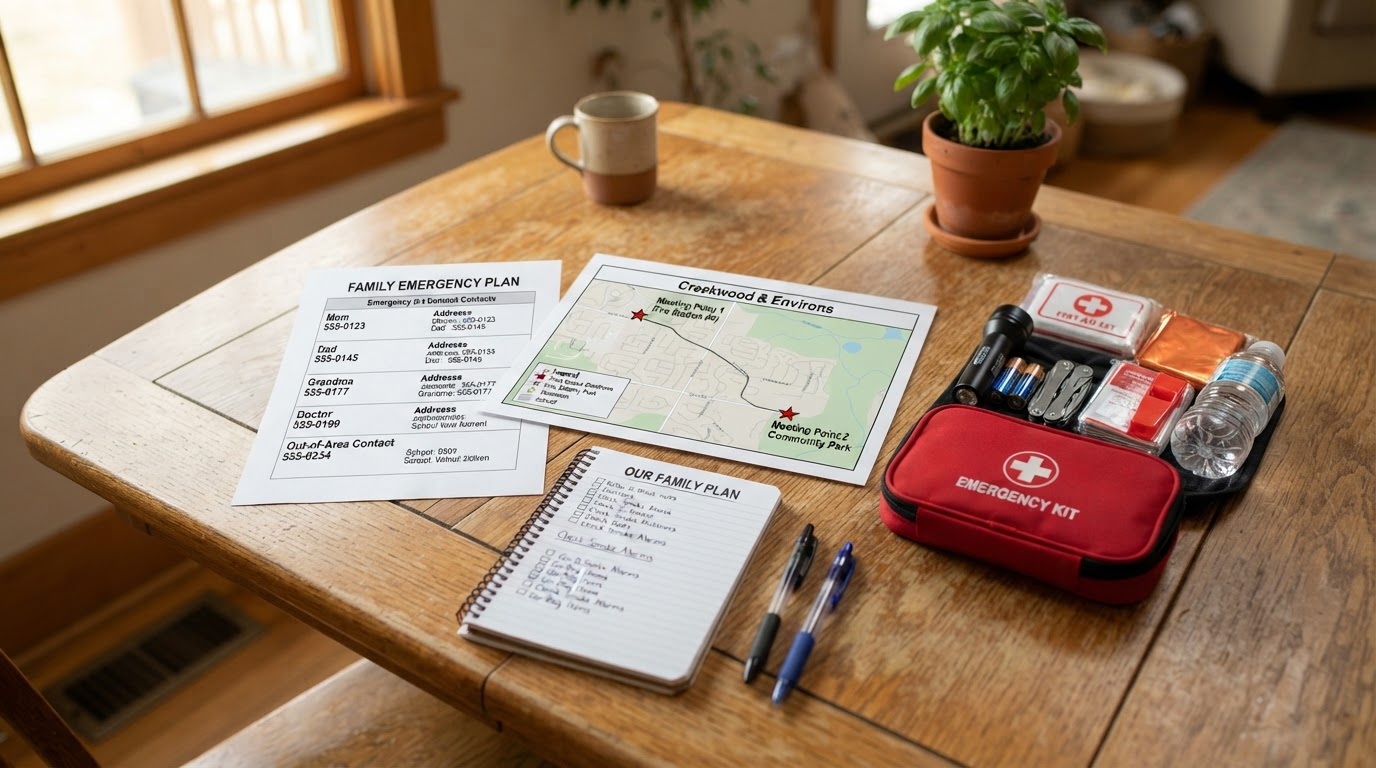
Family Emergency Plan
Family Emergency Plan: Contacts, Meeting Points, and Reunification
A family emergency plan is the agreement that keeps your household connected and safe when normal communication fails. This guide helps you build one with contacts, meeting points, and a reunification strategy.
Quick Answer
A family emergency plan is a written agreement that covers how your household will contact each other, where you will meet, and how you will reunite if separated during a disruption. It includes an out-of-area contact, a meeting point near home, a second one outside the neighborhood, and clear roles for each family member.
Key Takeaways
- •An out-of-area contact often works when local calls do not.
- •Choose two meeting points: one near home and one outside the neighborhood.
- •Assign clear roles so everyone knows what to do.
- •Practice the plan twice a year so it works under stress.
Why a Family Emergency Plan Matters
During a disaster, local phone networks are often overloaded. Text messages may go through when calls do not. An out-of-area contact can relay messages between family members who cannot reach each other directly. A plan turns panic into a sequence of steps.
A written plan also helps children, visitors, and caregivers know what to do even if you are not there to guide them.
The Four Parts of a Family Emergency Plan
Cover each of these in writing.
- •Contacts: an out-of-area check-in person and key phone numbers written down.
- •Meeting points: one near home for sudden emergencies, one outside the neighborhood if you cannot go home.
- •Roles: who gathers supplies, who handles pets, who shuts off utilities.
- •Information: how each person will receive alerts and official instructions.
Reunification When You Are Separated
Reunification is the hardest part of any family plan because family members may be at work, school, or in transit when a disaster strikes. Agree on a primary meeting point and a backup. If roads are blocked, decide how you will communicate and where you will wait.
An out-of-area contact is valuable here. If local lines are jammed, each family member calls the out-of-area contact, who relays messages and tracks everyone's status.
Special Considerations for Your Plan
Tailor the plan to your household. Families with children should coordinate with schools about pickup procedures. Households with older adults or people with disabilities should identify who will assist them and how. Pet owners need a plan for animals, including carriers and a pet-friendly destination if you evacuate.
Review the plan whenever a family member moves, a school changes, or contact information updates. A plan that is out of date is barely better than no plan.
Family Emergency Plan Template
| Element | What to fill in |
|---|---|
| Out-of-area contact | Name, phone, relationship |
| Meeting point 1 | Near home, specific address |
| Meeting point 2 | Outside neighborhood, specific address |
| Utility shutoff | Who does it, where the tools are |
| Pet plan | Who handles pets, carriers, food |
| School/work contacts | Phone numbers and pickup procedures |
| Medical needs | Conditions, medications, doctors |
Frequently Asked Questions
Why do I need an out-of-area contact?
Local phone networks are often overloaded during a disaster. Long-distance calls and texts to someone outside the area frequently go through when local ones do not.
How many meeting points should we have?
At least two: one near home for sudden emergencies like a fire, and one outside the neighborhood in case you cannot return home.
How often should we practice our family emergency plan?
At least twice a year. A practice run reveals gaps and keeps the plan fresh in everyone's mind.
What should I do if family members are at work or school?
Include work and school contacts in the plan, agree on meeting points, and use an out-of-area contact to relay messages if local lines fail.