
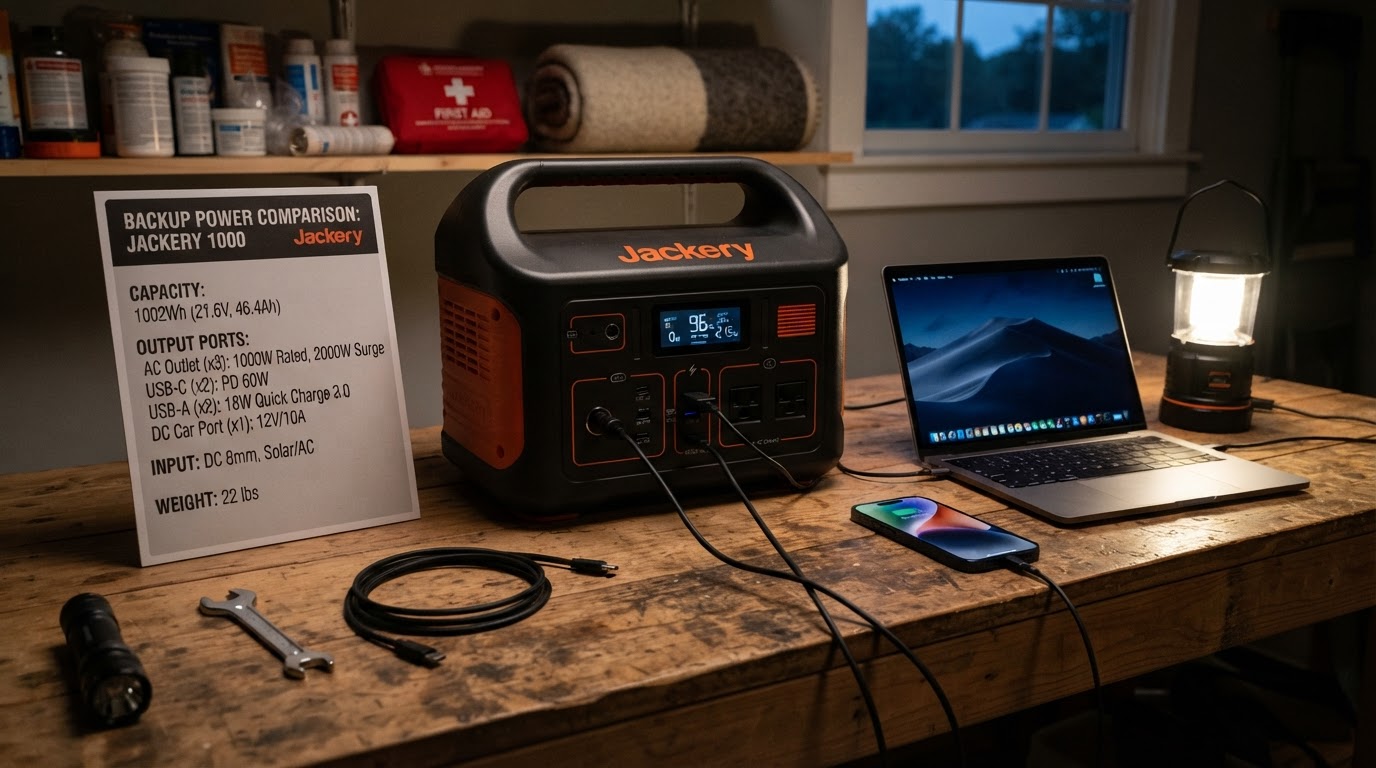
Best Portable Power Station
Best Portable Power Station: Capacity, Output, and Use Cases
A portable power station keeps phones, lights, and small devices running during an outage without the noise and exhaust of a generator. This guide explains how to compare stations by capacity, output, and portability so you choose one that fits your household.
Quick Answer
The best portable power station for your household depends on the devices you need to keep running and for how long. Compare stations by watt-hour capacity, continuous and surge output, charging options, and weight. A station that runs a phone for days is very different from one that runs a CPAP machine overnight. Size the station around your actual needs, not the largest capacity you can afford.
Key Takeaways
- •Match capacity in watt-hours to the devices you need to power.
- •Check continuous and surge output for compatibility with your devices.
- •Consider weight and portability if you may need to move it.
- •Rated capacity does not equal usable AC energy due to conversion losses.
Watt-Hours Versus Watts
Capacity is measured in watt-hours, which tells you how much energy the station stores. Output is measured in watts, which tells you how much power it can deliver at once. A station with 300 watt-hours can run a 50-watt device for about 6 hours, before accounting for conversion losses.
Rated capacity does not equal usable AC energy. Inverters lose energy converting DC battery power to AC, so a 300-watt-hour station may deliver about 250 watt-hours of usable AC power. Check the manufacturer's stated usable capacity if available.
Continuous and Surge Output
Continuous output is the wattage a station can deliver steadily. Surge output is the brief extra wattage it can deliver to start a device with a motor or compressor, like a fridge. If your device needs more surge than the station can provide, it will not start.
List the devices you need to run and check both their running wattage and starting wattage. Add them up to compare against the station's output. A phone or light draws little; a CPAP machine, a router, or a small fridge draws more.
Charging Options and Compatibility
- •AC wall charging: the standard way to refill the station at home.
- •Car charging: slower, but useful on the road or during an outage.
- •Solar charging: requires a compatible panel and good conditions.
- •Output ports: check AC outlets, USB ports, and DC outputs for your devices.
Battery Chemistry and Cycle Life
Most stations use lithium-ion or lithium iron phosphate (LiFePO4) batteries. LiFePO4 generally lasts more charge cycles and is considered more stable, but is heavier. Cycle life tells you how many charge and discharge cycles the battery is rated for before its capacity drops.
Do not assume a station is compatible with a medical device without verifying the device's power requirements and the station's output. If you rely on a CPAP or other medical equipment, check the manufacturer's power specifications and confirm compatibility before buying.
Power Station Sizing Examples
| Use case | Estimated need | Minimum capacity |
|---|---|---|
| Phone charging (3 days) | ~30 Wh/day | 100 Wh |
| Phone, light, radio (1 day) | ~100 Wh/day | 200 Wh |
| CPAP overnight | ~300 Wh/night | 500 Wh |
| Router and modem (8 hours) | ~80 Wh | 200 Wh |
| Small fridge (4 hours) | ~200 Wh | 500 Wh+ surge capacity |
Frequently Asked Questions
How long will a portable power station run my phone?
It depends on the station's capacity and your phone's battery. A 300-watt-hour station can charge a phone roughly 15 to 20 times, before accounting for conversion losses. Check the manufacturer's stated charge count.
Can a portable power station run a refrigerator?
Some can, but only for a short time and only if the station has enough surge output to start the compressor. Check the fridge's running and starting wattage against the station's continuous and surge ratings. Runtime is limited.
Is a power station safe for a CPAP machine?
Some stations are compatible, but not all. Check the CPAP manufacturer's power specifications and the station's output. Verify compatibility before buying, and do not assume any station works with any medical device.
Does rated capacity equal usable power?
No. Inverters lose energy converting DC to AC, so usable AC energy is lower than rated battery capacity. A 300-watt-hour station may deliver about 250 watt-hours of usable AC power. Check the manufacturer's stated usable capacity.