
Best Emergency Water Filter
Best Emergency Water Filter: Selection Guide and Performance Limits
An emergency water filter is a backup when stored water runs low or your usual supply is interrupted. This guide compares filter types, explains what each one can and cannot remove, and helps you choose one that fits your household.
Quick Answer
The best emergency water filter for your household depends on your water source, how many people you serve, and what you need to remove. No household filter removes every contaminant. Compare gravity, pump, squeeze, and bottle filters by their documented treatment capabilities, flow rate, and replacement cost, and understand that a filter supplements stored water rather than replacing it.
Key Takeaways
- •Match the filter type to your likely water source and group size.
- •Read the documented treatment claims; no filter removes every contaminant.
- •A filter supplements stored water; it does not replace it.
- •Boiling remains a reliable backup method in many situations.
What a Water Filter Can and Cannot Do
A water filter reduces specific contaminants so water is safer to drink. The key is reading the manufacturer's documentation to understand exactly what a filter removes. Some reduce bacteria and protozoa. Fewer reduce viruses. Most do not remove chemical contaminants, heavy metals, or dissolved salts.
A filter does not make every water source safe. If water is chemically contaminated, heavily polluted, or under a boil water advisory for chemical reasons, filtration alone may not be enough. Follow local advisories and use the treatment method they recommend.
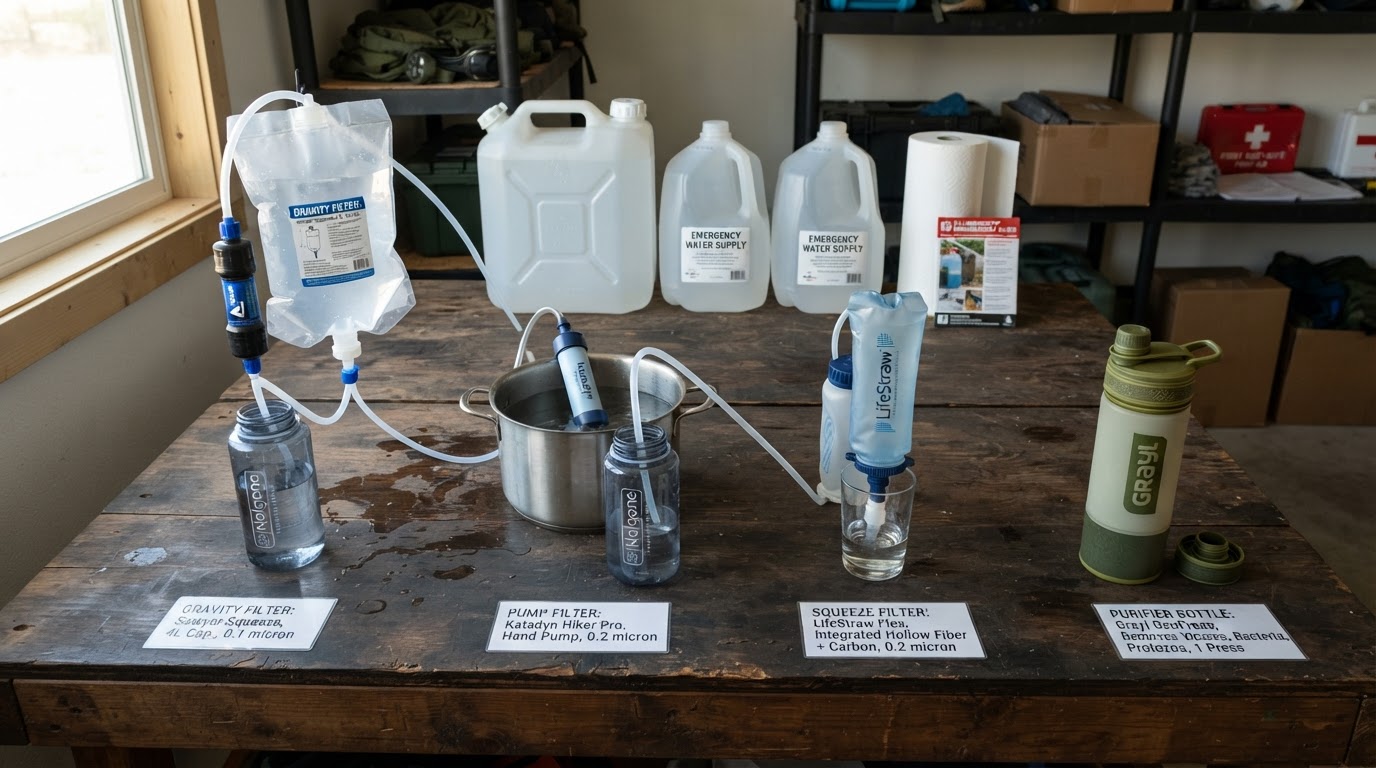
Comparing Filter Types
Each type suits a different situation.
- •Gravity filters: large capacity, no pumping, slower flow. Good for groups and base camps.
- •Pump filters: fast, controllable, work effort. Good for smaller groups and variable sources.
- •Squeeze filters: compact, lightweight, moderate flow. Good for individuals and travel.
- •Bottle filters: simplest to use, built into a bottle. Good for one person.
Key Specifications to Compare
Flow rate tells you how fast the filter produces clean water. A slow filter can be frustrating during an actual emergency. Capacity refers to how much water the filter can treat before the element needs replacement. Compare replacement element costs, since some filters are cheap to buy but expensive to maintain.
Look for documented performance against bacteria, protozoa, and viruses. Not all filters address all three. If your concern is backcountry water, bacteria and protozoa may be the priority. If your concern is municipal water quality during a disruption, follow local advisories for the right treatment.
Limitations and Maintenance
Filters clog, freeze, and expire. Store the filter according to the manufacturer's instructions, and keep replacement elements on hand. A frozen filter may be damaged, so protect it from freezing if you store it in a cold area.
Practice using your filter before you rely on it. Know how to clean it, how to tell when the element needs replacement, and how to store it between uses. A filter you have never used is a guess, not a plan.
Emergency Water Filter Comparison
| Type | Best for | Key advantage | Main limitation |
|---|---|---|---|
| Gravity | Groups, base camp | Hands-free, large capacity | Slow flow rate |
| Pump | Small groups, variable sources | Fast, controllable | Requires effort |
| Squeeze | Individuals, travel | Compact, lightweight | Lower capacity |
| Bottle | One person | Simplest to use | Limited volume |
Frequently Asked Questions
Does a water filter remove viruses?
Some do, but not all. Read the manufacturer's documentation. If your concern is viruses, choose a filter or purifier rated for viral reduction, or use boiling as a backup.
Can a water filter make chemically contaminated water safe?
Most household filters do not remove chemical contaminants, heavy metals, or dissolved salts. Follow local water advisories for the correct treatment method in those cases.
Do I still need stored water if I have a filter?
Yes. A filter supplements stored water but does not replace it. Store enough water for your household and keep a filter as a backup.
How do I maintain an emergency water filter?
Follow the manufacturer's instructions for cleaning, storage, and element replacement. Protect it from freezing, keep replacement elements on hand, and practice using it before you need it.