The Smart Prepper

Commuters, families, rideshare drivers, road-trip travelers, and people driving in isolated areas.

A Vehicle Emergency Kit for Everyday Breakdowns and Delays.

Prepare for realistic roadside problems with supplies suited to the vehicle, your passengers, and the climate you drive in.

Build My Checklist

Who it's for

Commuters, families, rideshare drivers, road-trip travelers, and anyone who drives in isolated or variable-climate areas.

Situations

Flat tires, dead batteries, empty tanks, winter stranding, long traffic delays, and breakdowns far from help.

Stored where

Secured in the vehicle's cargo area or under a seat — never loose where it could become a projectile.

First three actions

  1. 1.Gather what you already own: jumper cables, a flashlight, a first-aid kit, a phone charger.
  2. 2.Add water, shelf-stable snacks, and a warm blanket for your climate.
  3. 3.Add a tire-pressure gauge and learn your vehicle's spare-tire setup.

Limitations: This kit handles common roadside problems and short delays, not every emergency. It does not replace roadside assistance, official instructions, or safe judgment about whether to stay in or exit your vehicle.

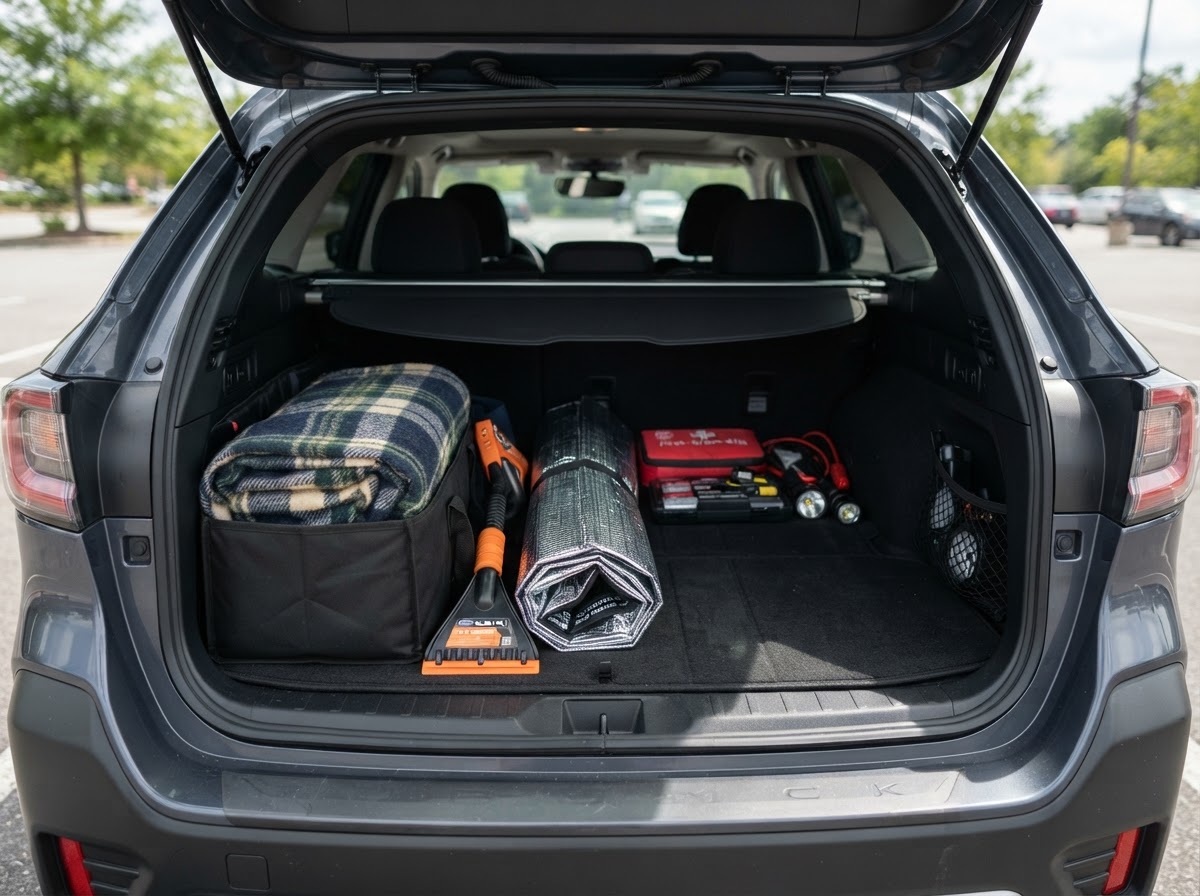
An organized emergency bag secured in a parked vehicle's cargo area.
A vehicle kit lives in your car — it must tolerate temperature swings and stay secured.
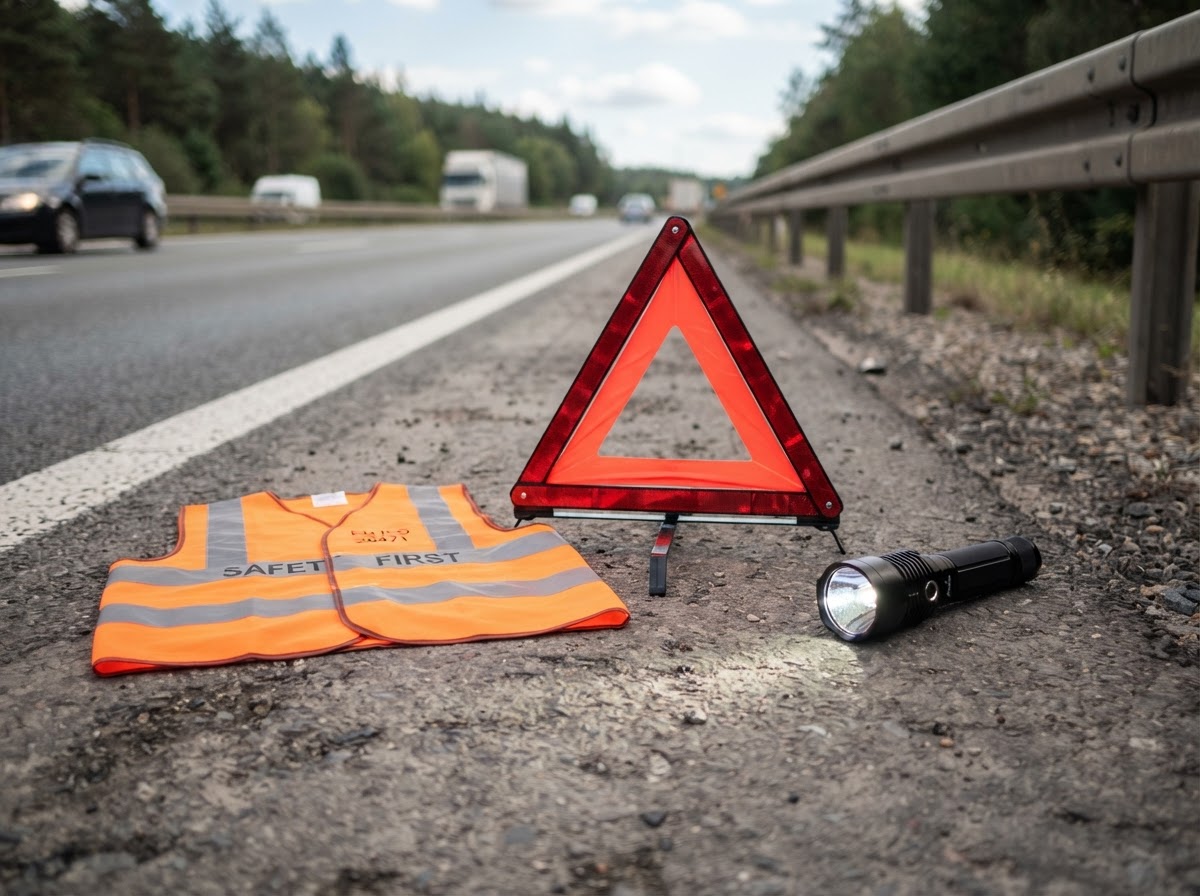
High-visibility vest, reflective triangles, and a flashlight laid out together.
Visibility gear keeps you safe on the shoulder — but never place it in active traffic.
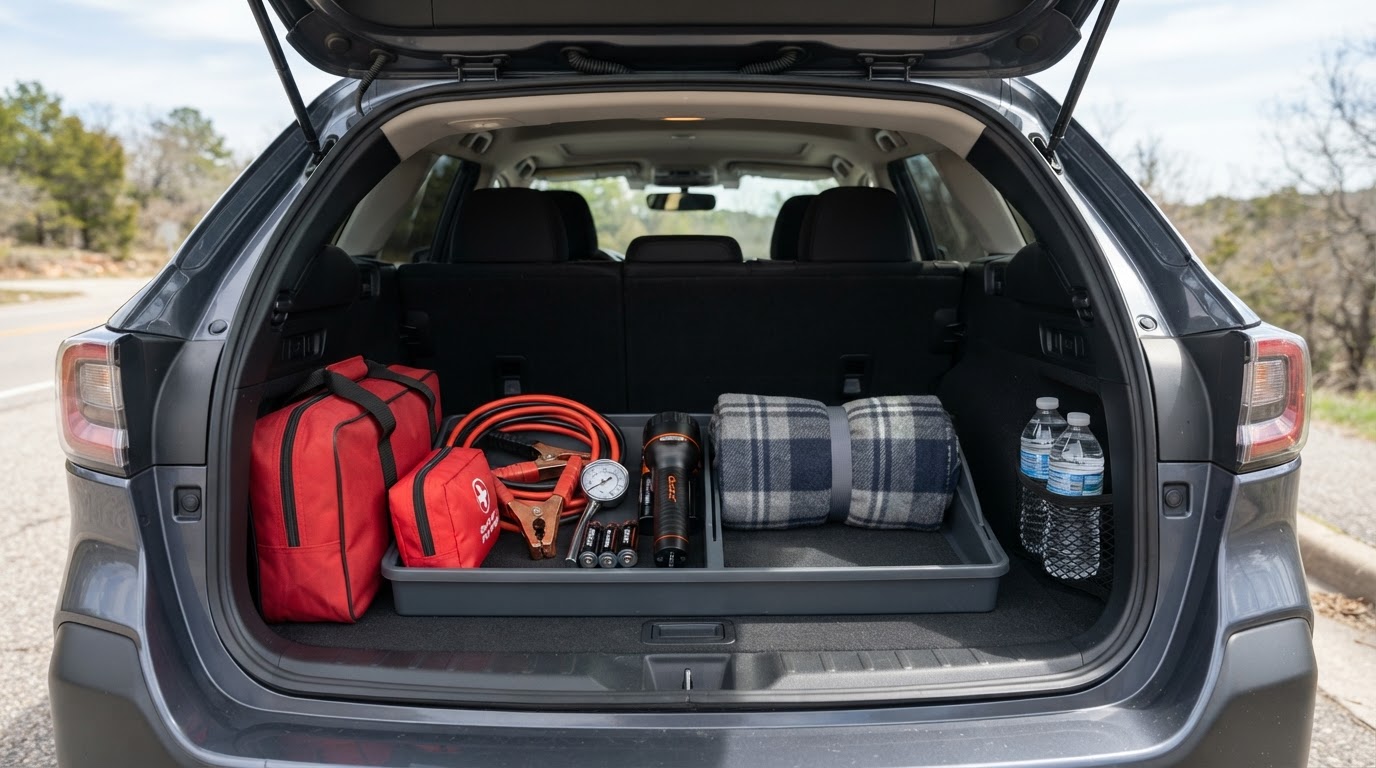
Climate-specific supplies: a warm blanket, water, and seasonal clothing.
Adapt the kit to the seasons — a winter kit looks different from a summer one.
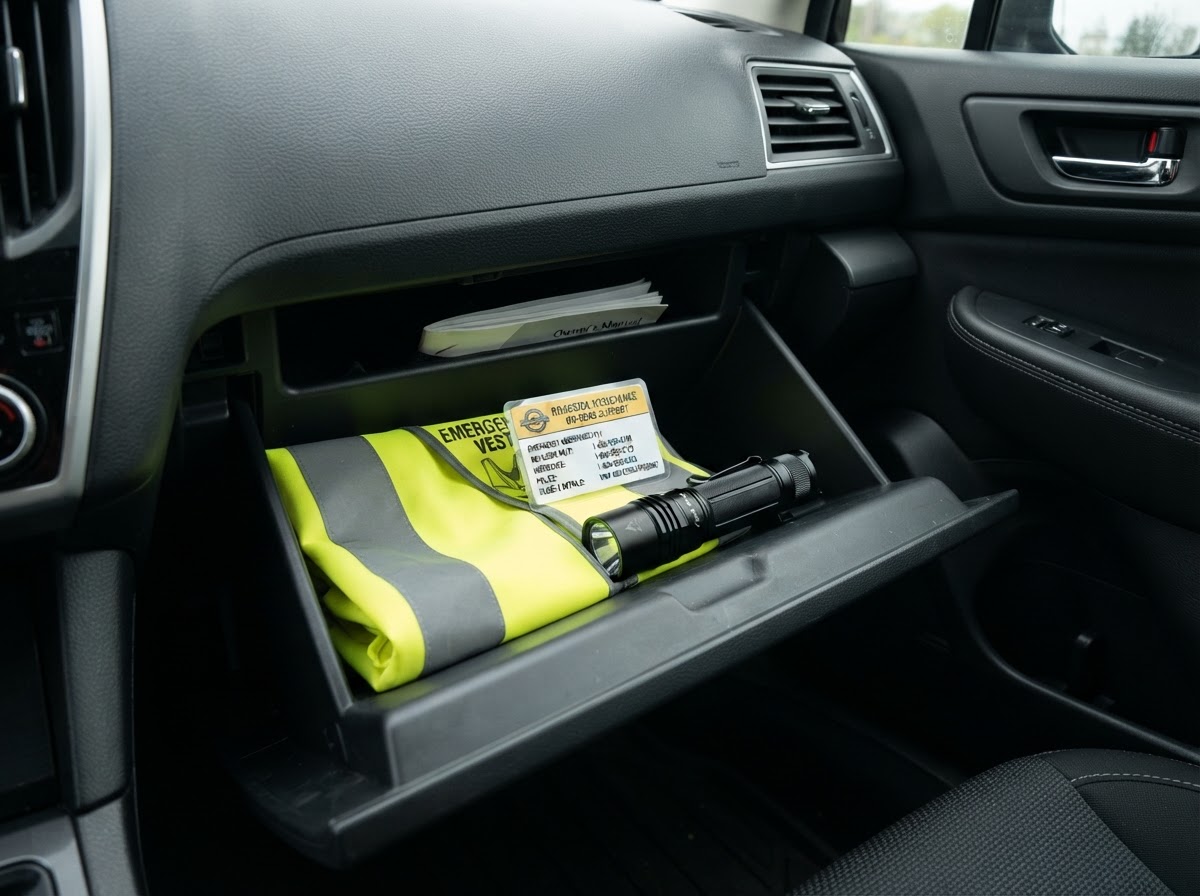
A compact roadside contact card with emergency numbers.
Keep key numbers on paper — a dead phone turns a minor breakdown into a serious one.

Start with these essentials

Prioritized by importance. Mark what you already own — then fill the gaps.

Core
  • ☐Jumper cables (and knowledge of safe use)
  • ☐Tire-pressure gauge
  • ☐Flashlight or headlamp with spare batteries
  • ☐First-aid kit
  • ☐Phone charger (car + USB) and a power bank
  • ☐Drinking water and shelf-stable snacks
  • ☐Printed emergency contact card
Situational
  • ☐Reflective triangles or a high-visibility vest
  • ☐Warm blanket or sleeping bag for cold climates
  • ☐Tire patch kit or sealant
  • ☐Tow strap
  • ☐Paper road map of your region
  • ☐Seasonal clothing (hat, gloves, rain gear)
Optional
  • ☐Portable jump-start battery (follow manufacturer instructions)
  • ☐Compact shovel and traction aid (sand/kitty litter)
  • ☐Spare headlamp bulbs
  • ☐Basic tool kit with your vehicle's common wrench sizes

Full kit guide

Build for the trips you actually take

A vehicle kit should match your real driving, not a worst-case fantasy. A daily commuter in a mild climate needs jumper cables, a phone charger, water, and a basic first-aid kit. A family that drives mountain passes in winter needs a warm blanket, a shovel, traction aid, and a more robust plan. A rideshare driver who spends hours daily in the car needs more comfort supplies — snacks, water, a phone charger — because they are more likely to face long delays. Start with the breakdowns you are statistically likely to face: dead batteries, flat tires, empty tanks, and being stuck in traffic. Then add climate- and terrain-specific items. A kit that fits your life gets used and maintained; a kit built for a scenario you never encounter gets ignored until it is useless.

The first decisions after a breakdown

When your vehicle breaks down, the first decisions are about safety, not repair. Pull as far off the road as possible. Turn on your hazard lights. Assess whether it is safer to stay in the vehicle or exit — this depends on roadway position, traffic, weather, fire, flooding, and official instructions. There is no universal 'stay in' or 'get out' rule. On a busy highway with no shoulder, staying in the vehicle with hazards on is often safest. On a quiet road with a wide shoulder, exiting to set up visibility gear may be safer. If you exit, do so on the side away from traffic. Do not place warning equipment in active traffic. Call roadside assistance or 911 if anyone is hurt or you are in a dangerous spot. A charged phone and a printed contact card are your most important tools in the first minutes.

Communication and visibility

A dead phone turns a minor breakdown into a serious one. Keep a car charger and a charged power bank. Keep a printed contact card with roadside assistance, insurance, and emergency numbers — do not rely on a phone that may be dead or out of signal. For visibility, reflective triangles or a high-visibility vest make you visible to other drivers if you are on the shoulder at night. Place triangles behind your vehicle only when it is safe to walk back — never step into active traffic to set them up. A headlamp leaves your hands free if you need to work or walk. In rural areas with no cell signal, a printed map and a plan to reach the nearest town matter more than any app. Tell someone your route and expected arrival before you drive into a remote area.

Comfort during delays

Many roadside events are long waits, not emergencies. A traffic jam, a tow truck that takes two hours, or a road closure can strand you for hours. Comfort supplies turn a miserable wait into a manageable one. Keep drinking water and shelf-stable snacks that tolerate temperature swings — granola bars, nuts, crackers. Avoid chocolate or anything that melts in a hot car. A warm blanket or sleeping bag is essential in cold climates; you may wait hours for a tow in winter. Keep seasonal clothing accessible: a hat, gloves, and rain gear. If you travel with children or pets, add their comfort items and water. A phone charger keeps you connected and able to call for updates. Comfort is not a luxury in a vehicle kit — it is what keeps a delay from becoming a crisis.

Tire and battery equipment suited to your vehicle

Dead batteries and flat tires are the most common roadside problems. Jumper cables are the single most useful item — but only if you know how to use them safely and can find a willing donor vehicle. If you are unsure, a portable jump-start battery is a simpler alternative; follow the manufacturer's instructions exactly, since procedures vary by device. For tires, a pressure gauge lets you check inflation, and a patch kit or sealant handles slow leaks and minor punctures. Know your vehicle's spare-tire setup: does it have a full spare, a donut spare, or a tire-inflation kit instead of a spare? Each requires different planning. Check your owner's manual for jacking points and lug-nut torque. If you are not comfortable changing a tire, that is fine — keep the gauge and sealant, and rely on roadside assistance for the rest. Never change a tire in an unsafe roadside location; wait for a tow to a safer spot.

Hot-weather and cold-weather adaptations

Climate changes your kit dramatically. In cold weather, a warm blanket or sleeping bag can prevent hypothermia if you are stranded overnight waiting for a plow. Keep it in the passenger compartment, not the trunk, if you might need it without exiting. A compact shovel and a bag of sand or kitty litter help you regain traction on ice or snow. In hot weather, extra water is critical — heat and a breakdown can become dangerous fast. Never leave pets or children in a parked vehicle in heat, even briefly. Avoid storing heat-sensitive items like medications or certain batteries in a vehicle that reaches extreme temperatures; check product temperature ratings. Rotate water and snacks seasonally — a water bottle left in a hot car all summer is not safe to drink. Adapt the kit twice a year when the seasons change.

Storage conditions that damage supplies

A vehicle is a harsh environment. Interior temperatures swing from below freezing to over 140°F, which damages many supplies. Water bottles degrade in heat; replace them seasonally. Snacks expire faster in a hot car; rotate them every few months. Batteries lose charge in cold and leak in heat; check them twice a year. First-aid adhesives fail in temperature extremes; inspect packaging. Keep the kit in a soft bag or secured bin that will not become a projectile in a sudden stop. Do not store medications or heat-sensitive electronics in the vehicle long-term; keep them in a bag you bring inside. A kit that is never inspected becomes a box of broken, expired, useless items. Set a reminder to check it when you change your clocks.

Passenger-specific additions

Adapt the kit to who rides with you. If you drive children, add their snacks, water, and a comfort item. If you drive with pets, add a leash, water, a bowl, and waste bags — and never leave them in a hot vehicle. If you drive elderly family members, consider their medication and mobility needs. If you carpool or rideshare, extra water and a phone charger are practical. If you drive in areas with poor cell coverage, a printed map and a plan to reach the nearest town matter. Think about your regular passengers, not a generic list. A kit that fits the people actually in your car is the one that helps when something goes wrong.

Checking the kit before a long trip

Before a road trip, do a quick kit check. Verify the flashlight works and batteries are charged. Confirm water and snacks are fresh. Check the first-aid kit for damaged packaging. Make sure jumper cables and the tire gauge are where you expect. Top off the fuel tank and note nearby gas stations on your route. Tell someone your route and expected arrival. If you are driving into winter or remote areas, add seasonal items: a blanket, shovel, traction aid, and extra water. A five-minute check before a long trip prevents discovering your kit is empty or broken when you are hours from help. Make it a habit, like checking your mirrors before you drive.

What belongs in a vehicle and what needs another storage plan

A vehicle kit is for roadside problems and short delays, not for everything. Do not store valuable documents, large amounts of cash, or sensitive medications in a vehicle long-term — they belong in a secure, temperature-stable location. Do not store firearms or anything that could be stolen. A vehicle kit is not a substitute for a home kit; the same physical item cannot be in two places at once unless you have duplicates. If you keep a blanket in the car, you do not also have it at home unless you buy a second one. Plan for the overlap: a small go-bag that lives in the car can supplement a home evacuation kit, but do not assume your home supplies are available when you are on the road. Keep vehicle and home kits separate and maintained.

Customize your checklist

Adjust quantities, mark what you own, add custom items, and download your plan.

Your checklist

Progress is saved in this browser. It does not sync across devices — use export to back up or transfer.

0%

Checklist completion

37

Applicable

0

Fully stocked

37

Still needed

—

Est. remaining cost

Jumper cables

core

Most useful roadside item; know safe use.

Applies: All vehicles.

1 more needed to reach target

Tire-pressure gauge

core

Check inflation regularly.

Applies: All vehicles.

1 more needed to reach target

Flashlight or headlamp

core

With spare batteries; headlamp frees hands.

Applies: All vehicles.

1 more needed to reach target

First-aid kit

core

Bandages, antiseptic, gauze, reference card.

Applies: All vehicles.

1 more needed to reach target

Phone charger (car + USB)

core

Keep phone alive; dead phone = serious problem.

Applies: All vehicles.

1 more needed to reach target

Power bank

core

Backup if car power is unavailable.

Applies: All vehicles.

1 more needed to reach target

Drinking water

core

Tolerates temperature swings; rotate seasonally.

Suggested: 1 gal/person

Applies: All vehicles.

1 more needed to reach target

Shelf-stable snacks

core

Granola bars, nuts, crackers; avoid meltable foods.

Applies: All vehicles.

1 more needed to reach target

Printed emergency contact card

core

Roadside, insurance, 911 on paper.

Applies: All vehicles.

1 more needed to reach target

Reflective triangles or vest

situational

Makes you visible; never place in active traffic.

Applies: All vehicles.

1 more needed to reach target

Warm blanket or sleeping bag

situational

For cold-weather stranding; keep in cabin.

Applies: Cold-climate drivers.

1 more needed to reach target

Tire patch kit or sealant

situational

For slow leaks and minor punctures.

Applies: All vehicles.

1 more needed to reach target

Tow strap

situational

For pulling out of a ditch with a helper vehicle.

Applies: Rural or winter drivers.

1 more needed to reach target

Paper road map

situational

Backup when GPS/cell fails.

Applies: Rural or road-trip drivers.

1 more needed to reach target

Seasonal clothing (hat, gloves, rain gear)

situational

Match the season you drive in.

Applies: All vehicles.

1 more needed to reach target

Portable jump-start battery

optional

Works alone; follow manufacturer instructions.

Applies: If unsure about jumper cables.

1 more needed to reach target

Compact shovel

optional

For snow or mud; traction aid.

Applies: Winter or off-road drivers.

1 more needed to reach target

Sand or kitty litter (traction aid)

optional

Regain traction on ice or snow.

Applies: Winter drivers.

1 more needed to reach target

Basic tool kit

optional

Your vehicle's common wrench sizes.

Applies: All vehicles.

1 more needed to reach target

Owner's manual

core

Jacking points, lug torque, spare setup.

Applies: All vehicles.

1 more needed to reach target

Spare tire (check condition)

situational

Know your setup: full, donut, or inflation kit.

Applies: If equipped.

1 more needed to reach target

Jack and lug wrench

situational

Match your vehicle; check location.

Applies: If equipped with a spare.

1 more needed to reach target

Roadside assistance membership info

situational

Number and account on the contact card.

Applies: All vehicles.

1 more needed to reach target

Insurance card

situational

Current copy in the vehicle.

Applies: All vehicles.

1 more needed to reach target

Registration copy

situational

Current copy in the vehicle.

Applies: All vehicles.

1 more needed to reach target

Pet water and bowl

situational

If you travel with pets.

Applies: If traveling with pets.

1 more needed to reach target

Pet leash and waste bags

situational

For safe stops with pets.

Applies: If traveling with pets.

1 more needed to reach target

Child snacks and water

situational

Extra for young passengers.

Applies: If driving with children.

1 more needed to reach target

Child comfort item

situational

For long delays with kids.

Applies: If driving with children.

1 more needed to reach target

Small emergency cash

situational

For tolls or when card readers are down.

Applies: All vehicles.

1 more needed to reach target

Dust mask

optional

For dust or poor air quality.

Applies: All vehicles.

1 more needed to reach target

Work gloves

optional

For handling cables or rough work.

Applies: All vehicles.

1 more needed to reach target

Seatbelt cutter / window breaker

optional

For escape from a stuck vehicle.

Applies: All vehicles.

1 more needed to reach target

Small fire extinguisher

optional

Rated for vehicle use; check mounting.

Applies: All vehicles.

1 more needed to reach target

Carbon-monoxide awareness

situational

Never run engine in enclosed space; clear exhaust if snowed in.

Applies: Winter drivers.

1 more needed to reach target

Spare flashlight batteries

situational

Matched to your light; check twice yearly.

Applies: If using battery lights.

1 more needed to reach target

Route plan shared with someone

situational

Tell someone your route and ETA before remote drives.

Applies: Rural or road-trip drivers.

1 more needed to reach target

Download center

Starter resources are blank templates. Personalized resources reflect your current selections.

Import backupRestore a JSON backup file.
PrintPrint this page via your browser.

Storage and packing guide

Build for the trips you actually take

A vehicle kit should match your real driving, not a worst-case fantasy. A daily commuter in a mild climate needs jumper cables, a phone charger, water, and a basic first-aid kit. A family that drives mountain passes in winter needs a warm blanket, a shovel, traction aid, and a more robust plan. A rideshare driver who spends hours daily in the car needs more comfort supplies — snacks, water, a phone charger — because they are more likely to face long delays. Start with the breakdowns you are statistically likely to face: dead batteries, flat tires, empty tanks, and being stuck in traffic. Then add climate- and terrain-specific items. A kit that fits your life gets used and maintained; a kit built for a scenario you never encounter gets ignored until it is useless.

The first decisions after a breakdown

When your vehicle breaks down, the first decisions are about safety, not repair. Pull as far off the road as possible. Turn on your hazard lights. Assess whether it is safer to stay in the vehicle or exit — this depends on roadway position, traffic, weather, fire, flooding, and official instructions. There is no universal 'stay in' or 'get out' rule. On a busy highway with no shoulder, staying in the vehicle with hazards on is often safest. On a quiet road with a wide shoulder, exiting to set up visibility gear may be safer. If you exit, do so on the side away from traffic. Do not place warning equipment in active traffic. Call roadside assistance or 911 if anyone is hurt or you are in a dangerous spot. A charged phone and a printed contact card are your most important tools in the first minutes.

Scenario walkthroughs

How this kit holds up in realistic situations — and what decisions matter.

Breakdown during a normal commute

Your car won't start in an office parking lot at 6 p.m. You turn on hazards, call roadside assistance from your charged phone, and wait in the car with water and a snack. You have a printed contact card with the tow number. The tow arrives in 45 minutes. The kit you used: phone charger, water, snack, contact card. No drama, because the basics were in place.

Long traffic delay in hot weather

A highway closure strands you for three hours in 95°F heat. You have extra water, snacks that tolerate heat, and a phone charger to check updates. You keep the windows cracked and the hazards on. You do not leave anyone in the car when you step out. The delay is uncomfortable but safe because you had water and a way to stay informed.

Winter travel disruption

A winter storm slides you into a ditch on a rural road at night. You stay in the vehicle with hazards on, call for help, and use the warm blanket while you wait. You have water and snacks. You do not attempt to walk for help in the dark and cold. A tow arrives in 90 minutes. The blanket and the decision to stay put kept you safe.

Common mistakes

✕Storing the kit loose in the cabin where it becomes a projectile in a stop.

✓Secure it in a cargo area or under a seat in a bag or bin that stays put.

✕Never checking the kit, so water and snacks expire or batteries die.

✓Inspect it twice a year when you change your clocks. Rotate water and snacks seasonally.

✕Storing medications or heat-sensitive batteries in a hot car.

✓Keep temperature-sensitive items in a bag you bring inside. Check product temperature ratings.

✕Stepping into active traffic to place warning triangles.

✓Only place visibility gear when it is safe to walk back. Never enter active traffic.

✕Assuming a universal 'stay in' or 'get out' rule after a breakdown.

✓Decide based on roadway position, traffic, weather, and official instructions. There is no one-size-fits-all answer.

✕Not knowing your vehicle's spare-tire setup.

✓Check your owner's manual. A full spare, a donut, or an inflation kit each require different planning.

✕Relying only on a phone for navigation and contacts.

✓Keep a printed map and a contact card. Phones die and lose signal in rural areas.

Maintenance schedule

CadenceTask
Every 6 monthsTest flashlight and power bank; recharge or replace batteries.
Every 6 monthsRotate water and snacks; discard anything expired or heat-damaged.
SeasonallySwap seasonal items — add blanket and shovel in fall, check water in spring.
AnnuallyInspect first-aid kit for damaged packaging and expired items.
AnnuallyUpdate the printed contact card with current numbers.
Before any long tripFive-minute kit check: lights, water, snacks, cables, gauge.

Downloads for this kit

Use the download center in the checklist above, or grab the page-specific extras:

Roadside Action Card

Key numbers and vehicle info to keep in the glovebox.

Seasonal Vehicle Review Sheet

Swap seasonal items twice a year.

Road-Trip Departure Checklist

A five-minute kit and vehicle check before a long drive.

Frequently asked questions

What are the most common roadside problems I should prepare for?
Dead batteries, flat tires, empty tanks, and long traffic delays top the list. Jumper cables, a tire-pressure gauge, water, snacks, a phone charger, and a first-aid kit cover the majority of roadside events.
Should I stay in my vehicle or get out after a breakdown?
It depends on roadway position, traffic, weather, fire, flooding, and official instructions. There is no universal rule. On a busy highway with no shoulder, staying in with hazards on is often safest. On a quiet road with a wide shoulder, exiting away from traffic may be safer. If unsure, stay in the vehicle and call for help.
Can I store medications in my car kit?
Generally no. Vehicle interiors reach extreme temperatures that degrade medications. Keep medications in a bag you bring inside, and add a reminder to grab them. Check product temperature ratings for anything you do store in the vehicle.
How do I handle a flat tire if I'm not comfortable changing it?
Keep a tire-pressure gauge and a sealant for slow leaks, and rely on roadside assistance for anything more. Never change a tire in an unsafe roadside location — wait for a tow to a safer spot. Knowing your limits is part of safe planning.
What should I add for winter driving?
A warm blanket or sleeping bag, a compact shovel, a bag of sand or kitty litter for traction, extra water, snacks, a hat and gloves, and a phone charger. Keep the blanket in the passenger compartment so you can reach it without exiting.
How often should I check my vehicle kit?
Twice a year when you change your clocks, and before any long trip. Rotate water and snacks seasonally — a water bottle left in a hot car all summer is not safe. Test the flashlight and power bank, and inspect the first-aid kit.
Is a portable jump starter better than jumper cables?
Each has tradeoffs. Jumper cables require a donor vehicle and knowledge of safe use. A portable jump starter works alone but must be kept charged and used per the manufacturer's instructions. If you are unsure about jump-starting safely, a portable unit is simpler.
What about driving with pets?
Add a leash, water, a bowl, and waste bags. Never leave pets in a hot vehicle, even briefly. If you travel with pets regularly, keep their comfort and water needs in the kit just as you would for children.
Do I need a paper map if I have GPS?
GPS depends on a charged phone and a cell signal, both of which can fail in rural areas. A paper road map of your region is a cheap, reliable backup. Mark your regular routes and alternate options.
How is a vehicle kit different from a home kit?
A vehicle kit handles roadside problems and short delays in a harsh temperature environment. A home kit covers longer disruptions with more storage. The same item cannot be in both places unless you have duplicates — keep vehicle and home kits separate and maintained.

Sources and review information

These organizations do not endorse The Smart Prepper. Guidance is summarized from current public sources; always follow official instructions during an emergency. Content is reviewed periodically — last reviewed when verified.