What an evacuation kit should accomplish
An evacuation order leaves little time. The kit that matters is the one you can grab in under five minutes and carry out the door — not the one buried in a closet. This go-bag is built for the moment you must leave: a fire approaching, a flood warning, or a mandatory evacuation. It holds what you need to function away from home for at least 24 to 72 hours, with an emphasis on documents, medications, and money that are difficult to replace. The goal is not to take everything you own — it is to leave quickly with what lets you survive and recover: identification, money, communication, medications, and basic supplies. Everything else is replaceable. Keep it near an exit, make sure everyone in the household knows where it is, and review its contents twice a year.
What to prepack
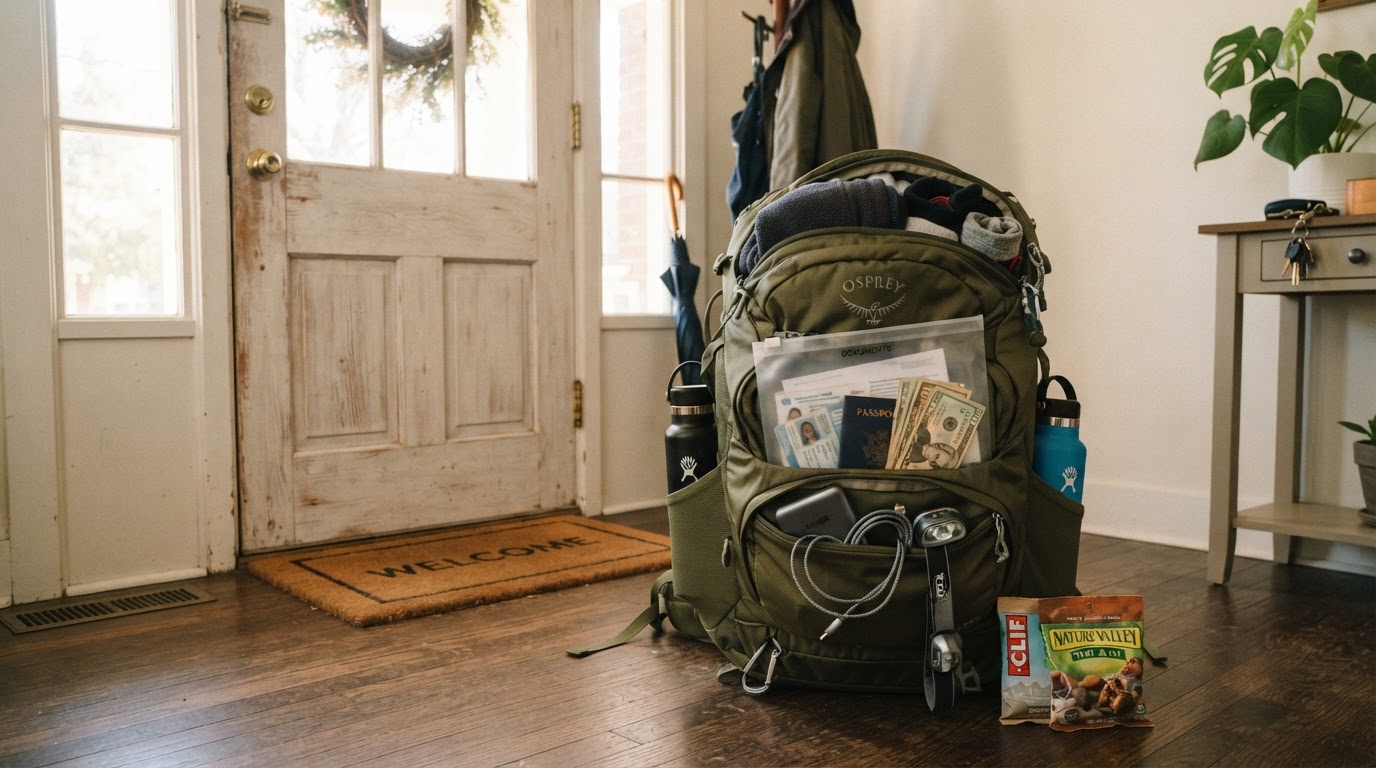
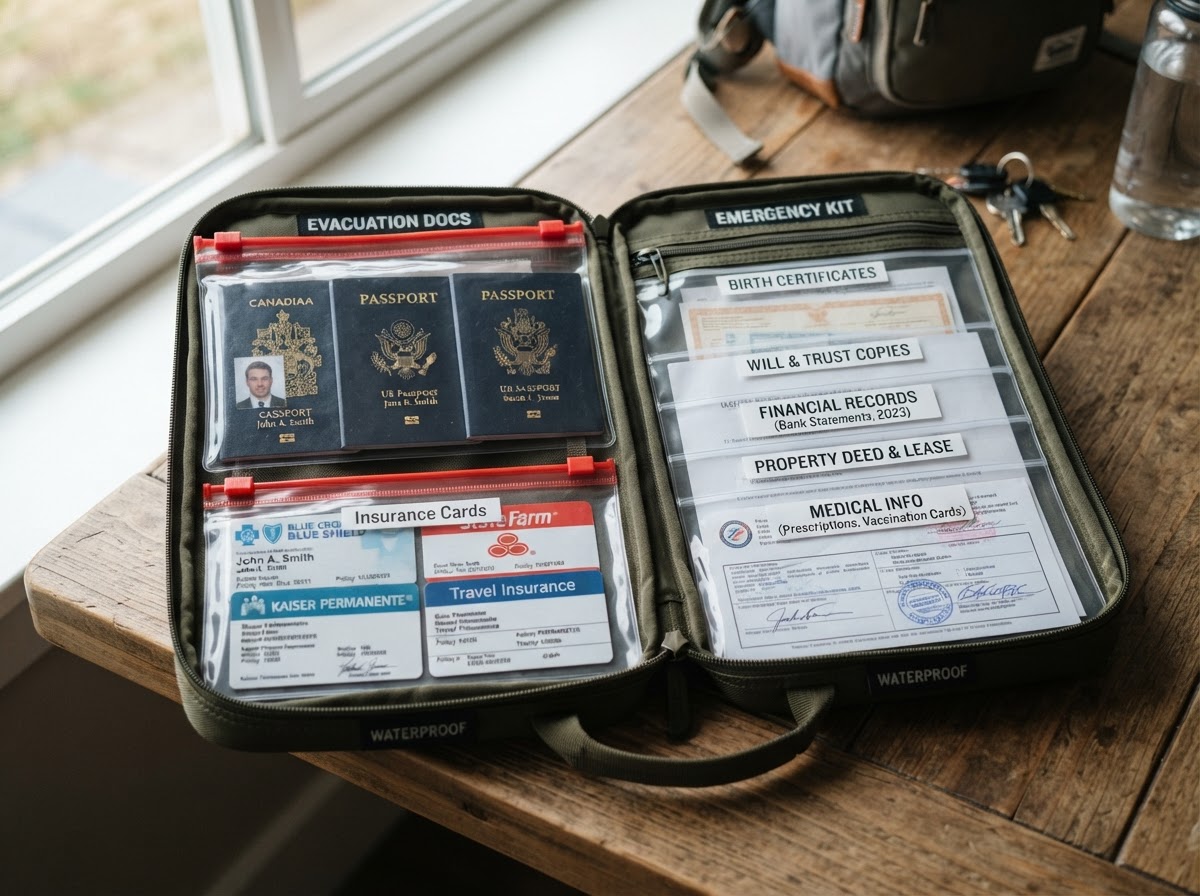
Prepack the things you would not have time to gather in a rush and that do not expire quickly. Copies of documents go in a waterproof bag: identification, insurance policies, medical records, prescriptions, property deeds, and financial account information. An encrypted USB drive with digital copies is a useful backup. Prepack a first-aid kit, a headlamp with spare batteries, a phone charger and a charged power bank, a change of clothes appropriate to the season, sturdy shoes, a small amount of cash in small bills, and a printed contact card with meeting points and an out-of-area contact. Prepack ready-to-eat food that does not need cooking. The point of prepacking is that these items are ready the instant you need them — you are not searching for them while smoke fills the hallway.
What to add when leaving
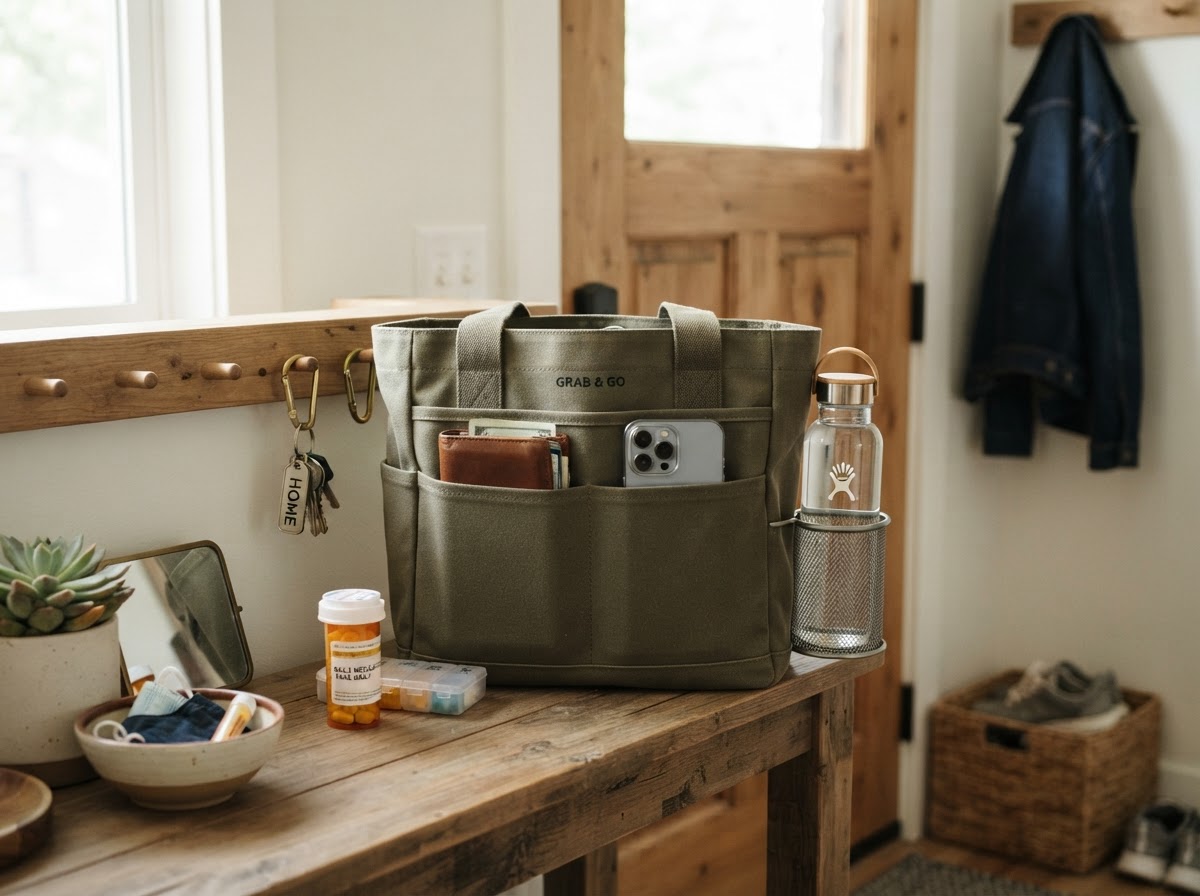
Some things cannot be prepacked because they expire, are used daily, or are too valuable to store in a bag. Keep a written last-minute list on top of the go-bag so you grab them without thinking. Medications: a seven-day supply from your normal, temperature-stable location. Wallet, phone, keys, and glasses. Important original documents if you keep them in a safe — grab them if there is time. Laptop or tablet and charger if you rely on them. Jewelry or small heirlooms if time allows. The last-minute list is what saves you from standing in the doorway trying to remember what to take. Separate it from the prepacked items so the distinction is clear: prepacked is ready now; last-minute is a checklist for the moment you leave.
Documents and contacts
The single most valuable part of an evacuation kit is your documents. Make copies of identification, insurance policies, medical records, prescriptions, property deeds, and financial account information. Store them in a waterproof bag. Include a list of emergency contacts and account numbers. If possible, keep digital copies on an encrypted USB drive as well. Originals can stay in a fireproof safe at home, but copies go in the go-bag. These documents are what you need to prove who you are, file insurance claims, refill prescriptions, and access money after an evacuation. Without them, recovery is far harder. Also include a printed contact card with two meeting points, an out-of-area contact, and key phone numbers — phones die and networks overload, so paper matters.
Choosing a bag you can actually carry
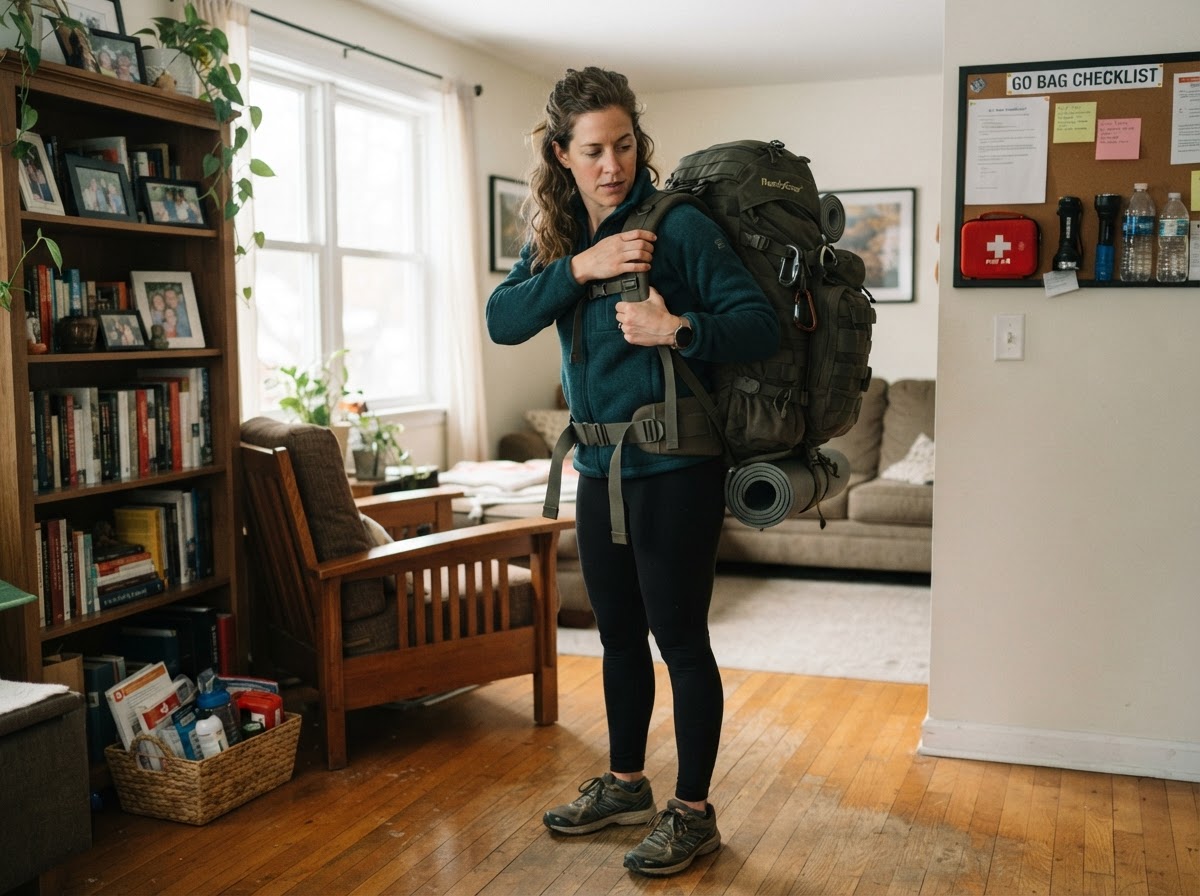
A bag you cannot carry is a bag you will abandon. Choose a backpack that fits your body and that you can walk with for an extended period. If you have children or mobility limits, account for that — you may need to carry a child's bag too, or use a rolling bag if you cannot carry weight on your back. Do not overpack; weight is the enemy of mobility. There is no universal safe bag weight based on body-weight percentage — what you can carry depends on your fitness, the terrain, and how far you must go. Practice carrying your loaded bag for ten minutes. If it is too heavy, remove non-essentials. Distribute weight across the household: each capable person carries their own bag. Keep the bag comfortable, with padded straps, and store it near an exit where you can grab it in the dark.
Water, food, and weight tradeoffs
Water is heavy — about 8 pounds per gallon — and you cannot carry much. The one-gallon-per-person-per-day baseline is a home-storage figure; carrying three days of water for a family is often impractical. Pack a smaller amount for immediate needs (a liter or two per person) and plan to obtain more at your destination or along the way. A water filter or purifier can help, but understand its limits — it does not make every source safe. For food, choose ready-to-eat, no-cook items: energy bars, nuts, dried fruit, trail mix. Avoid heavy or fragile packaging. The tradeoff is clear: every pound of water and food is a pound you carry. Prioritize documents, medications, and money over large food and water reserves. You can buy food and water; you cannot easily replace your identification or your medications.
Transportation and destinations
Plan how you will leave and where you will go. If you have a vehicle, keep it at least half-fueled during risk seasons — gas stations may be closed or without power during an evacuation. Identify a destination: a friend or relative outside your area, a hotel, or an official shelter. Do not rely on a single destination; have alternates. Identify two routes to your destination in case one is blocked. Do not assume any route is safe — conditions change, and official instructions override your plan. If you do not have a private vehicle, plan now: identify a neighbor or friend who could give you a ride, or learn your community's public evacuation options. Keep a paper map in the go-bag; GPS depends on a charged phone and a cell signal, both of which may fail. Write your destination and routes on paper so you do not rely on memory or a device.
Accessibility, children, and pets
An evacuation plan must account for everyone in your household. For household members with mobility or accessibility needs, plan transport and routes that work for them, and keep any necessary equipment accessible. For children, pack comfort items, a change of clothes, and age-appropriate food; assign older children their own small bag. For infants, pack formula, diapers, wipes, and a familiar blanket. For pets, pack food, water, a leash or carrier, and vaccination records — and remember that not all shelters accept pets, so identify pet-friendly options ahead of time. If someone uses powered medical equipment, that requires a separate plan for backup power during an evacuation. Do not leave anyone out of the plan. A household plan that ignores one member is not a household plan.
Practicing the departure routine
A go-bag you have never carried and never practiced with is a kit that will fail you when it matters. Run a household drill once a year: everyone grabs their bag and leaves in under five minutes. Time it. See what you forgot. Adjust. Practice the communication plan: everyone texts the out-of-area contact. Practice the route: drive or walk your primary evacuation route and an alternate. Practice carrying your loaded bag for ten minutes — if it is too heavy, fix it now, not during an emergency. The goal is a household that can respond calmly because it has rehearsed. Drills reveal the gaps you cannot see on paper: the bag that is too heavy, the contact number no one remembers, the route that is under construction. Practice is what turns a list into a plan.
Maintaining the kit and updating the plan
A go-bag is not build-once-and-forget. Review it twice a year — when you change your clocks is an easy trigger. Rotate food, water, and batteries. Check that medication backups are current and not expired. Update the contact card when numbers change. Update clothing for the season — a winter bag needs different clothes than a summer one. Review the destination and routes: do they still make sense? Has a friend moved? Is a road closed? Update the last-minute list when your daily items change — a new medication, a new phone, a new pair of glasses. After any household change — a move, a new family member, a new pet — review the whole plan. A kit that matched your life two years ago may no longer fit. Maintenance is what keeps a go-bag ready instead of forgotten.