
Browse by topic
Communication: staying connected when the network is not
Weather alerts, radios, satellite messaging, family plans, maps, offline information, and reunification — a communication plan that does not depend on one app.
A communication plan is the plan that reunites your family when the phones are down and the Wi-Fi is out. Build it before the network fails.
NOAA weather radio
Key tool
Printed contact card
Backup
Two meeting points
Reunite
Text, don't call
When jammed
Get the alerts that matter
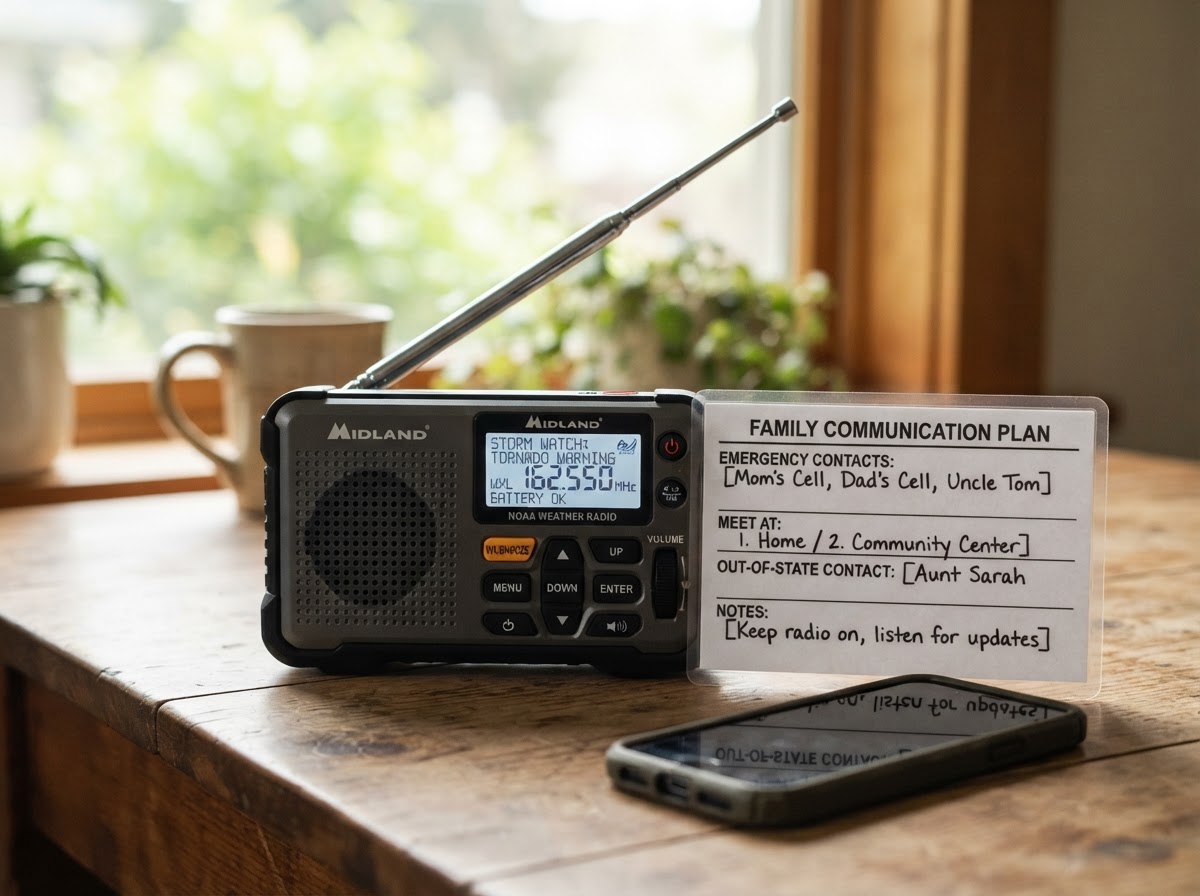
The first step in a communication plan is knowing when a disruption is coming. The National Weather Service issues alerts for the storms that cause most outages, and a NOAA weather radio receives them even when the cell network is congested or down. A battery or hand-crank model with SAME technology can alert only for your county. Keep one in the home and one in the go-bag. Sign up for your local Wireless Emergency Alerts — they are on by default on most smartphones, but verify in your settings. The alert is the start of the communication plan, not the plan itself.
Sign up for your utility's outage alerts if they offer them; many send texts with estimated restoration times. Sign up for your local emergency management agency's alerts — most counties use a system that texts evacuation orders and shelter information. The plan is to have multiple ways to receive alerts, because no single channel is reliable during a widespread event. The NOAA radio is the backup that works when nothing else does. The Smart Prepper's weather radio guide helps you choose one.
Build a family communication plan
Ready.gov's central message on communication is simple: have a plan that does not depend on one app. In an evacuation, family members may be separated — at work, at school, or on the road. Pick two meeting points: one right outside the home for a sudden emergency, and one outside the neighborhood if you cannot return. Designate an out-of-area contact, because local lines can be jammed while long-distance calls go through. Everyone in the household should have the out-of-area contact's number memorized or written down. The Smart Prepper's household contact card is built for this — a wallet-sized printout with the key numbers.
Text rather than call when the network is congested, because texts use less bandwidth and often get through when calls do not. Teach everyone in the household the plan — including children and anyone with mobility needs — so they can act if an adult is not there. Confirm the school's emergency release policy and who is authorized to pick up children. The communication plan is what turns a separated household back into a reunited one. A plan that is written, practiced, and kept on a printed card is a plan that works when the phones do not.
Review the plan each year. Walk through the meeting points, the out-of-area contact, and the contact card with everyone. A plan that sits in a drawer is a plan that fails the first time you need it. The communication plan is not about technology; it is about decisions made in calm that work in chaos. The fundamentals are the alerts, the meeting points, the out-of-area contact, and the printed card — and all of them are free.
Keep offline maps and information
If you rely on your phone for directions, an outage can leave you unable to navigate. Download offline maps for your area and your evacuation routes — most map apps allow this — and keep a printed map in the car. Know the roads to your destination without GPS, because the phone may be dead, out of range, or unable to reach a map server. A paper atlas or regional map is not a relic; it is a backup that never needs a signal. The Smart Prepper's offline navigation guide covers this in detail.
Keep a printed list of essential information: your emergency contacts, your utility's outage hotline, your insurance company's number, your doctor's number. In a crisis, you will not be able to look these up if the phone is dead. A printed contact card in each go-bag and each vehicle is the offline backup that works when the network does not. The communication plan includes the information plan: the printed numbers, the printed maps, and the knowledge of what to do when the digital tools fail.
Satellite messaging and radios
For households in remote areas or those who want a deeper backup, a satellite messenger can send texts when the cell network is down. Devices like a Garmin inReach or a phone with satellite capability can send an SOS or a check-in message from anywhere with a view of the sky. They require a subscription and have limitations — they are for messaging, not browsing — but they are the communication tool that works when the cell towers do not. The Smart Prepper's satellite guide compares the options. For local communication within a household or neighborhood, a pair of GMRS or FRS radios can work without any infrastructure, though range is limited and licensing considerations apply (GMRS requires an FCC license).
Do not rely on social media for emergency information during an outage, because the outage may take it with it. Use official sources — Ready.gov, your local emergency management agency, your utility — and verify before you act. Misinformation spreads fastest when the usual channels are down, and the plan is to act on verified information, not rumor. The communication plan is the alerts, the family plan, the offline maps, the satellite backup, and the discipline to verify. The fundamentals are about having multiple channels, not one — because no single channel is reliable during a widespread event.
Reunification: the goal of the plan
The communication plan exists for one purpose: to reunite the household if it is separated. Every element — the alerts, the meeting points, the out-of-area contact, the printed card, the offline maps — is in service of that goal. A household that can reunite after a disruption is a household that can recover. A household that cannot is a household that is still in crisis long after the event ends. The Smart Prepper's evacuation plan tool helps you build the reunification plan, with two routes and a meeting point.
Practice the plan once a year. Walk through it with the whole household: where you meet, who you call, what you grab, how you get there. A plan that is practiced is a plan that works. A plan that is not is a plan that fails. The communication page is where you build the plan that keeps your household connected when the network is not — and the fundamentals are the alerts, the family plan, the offline backup, the satellite option, and the practice. None of them are complicated; all of them require doing, not just buying.
Communication checklist
- NOAA weather radio with batteries
- Family communication plan written
- Out-of-area contact designated
- Two meeting points chosen
- Printed contact cards for each member
- Offline maps downloaded + printed
Sources & further reading
This is planning guidance, not emergency advice. In an emergency, call 911. See a mistake? Report it.
Explore other topics
Fundamentals
Household needs, risk prioritization, budgets, and gradual preparation — the foundation everything else builds on.
Water
Storage, containers, rotation, treatment concepts, and filter limitations — how to plan water before the tap stops.
Food
Ordinary pantry planning, dietary needs, rotation, shelf-stable foods, and cooking contingencies — food preparedness without the panic.
Medical Readiness
First-aid kits, training, sanitation, prescription continuity with clinicians, and medication storage — health preparedness done right.
Power & Light
Batteries, portable stations, solar, generators, charging, refrigeration, lighting, and carbon-monoxide prevention — power preparedness safely.