
A digital outage can come from a storm, a cyberattack, a fiber cut, or a simple equipment failure, and it takes more with it than people expect. No internet means no streaming, but it also means no banking app, no food delivery, no ride-share, and for many people, no way to reach family. Ready.gov treats digital preparedness as part of emergency planning, and the lesson is that the network is not guaranteed. This guide covers the offline backups that keep your household functional when the network is not — printed contacts, local cash, offline maps, and a plan for how to communicate when the usual channels are down.
Keep a printed contact card and a written plan
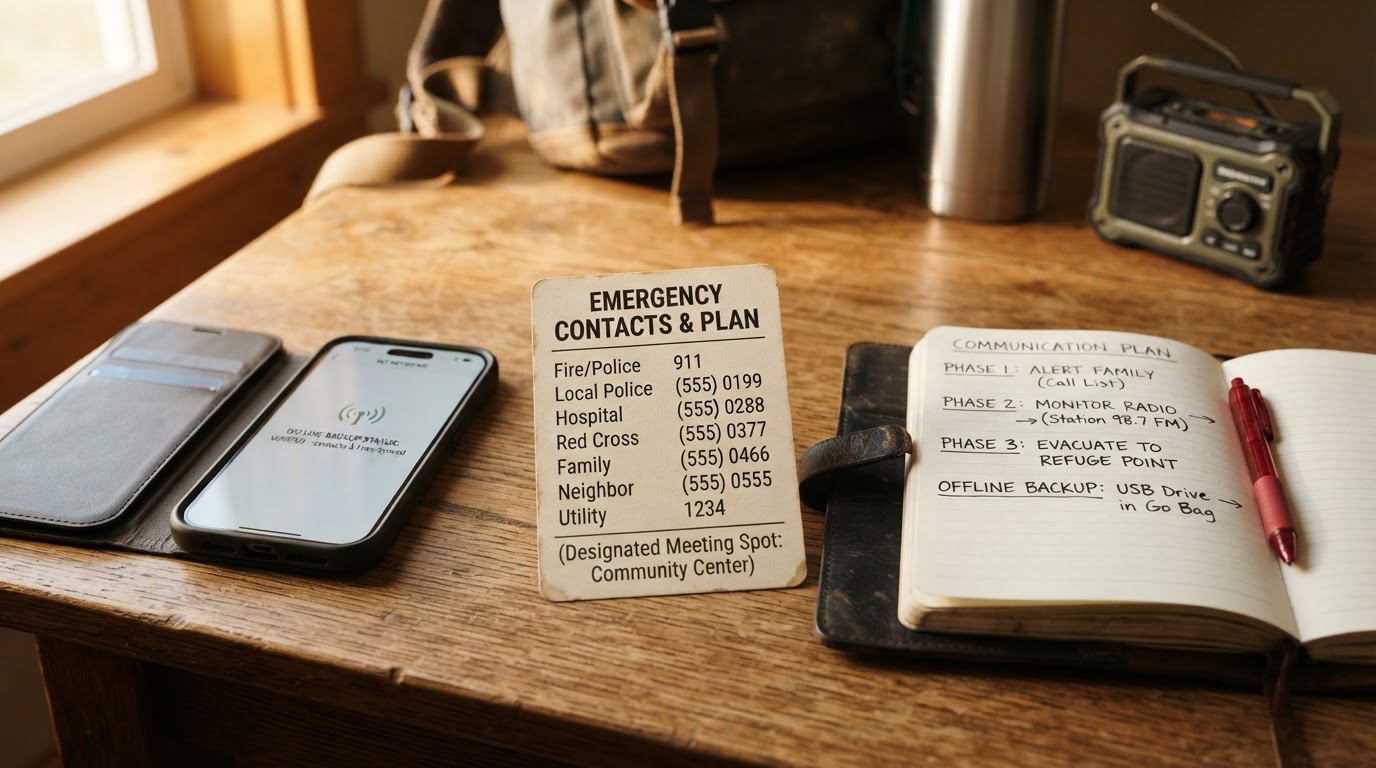
The first thing a digital outage takes is the ability to look up a phone number, so keep a printed contact card. Write the numbers you need in an emergency: household members, an out-of-area contact, your doctor, your insurance, your utility's outage line, and a trusted neighbor. The Smart Prepper's communication card is built for this. Keep one in each go-bag and one by the door, because the phone may be the thing that is dead. Memorize at least one number, because if the phone is gone and the card is lost, memory is the last backup.
Write down your household plan: where you will meet if separated, what the out-of-area contact is, and what to do in an evacuation. The Red Cross recommends reviewing it with everyone in the household, including children, so they can act if an adult is not there. The plan does not depend on the network; it depends on paper and memory.
Keep cash and offline payment options

When the network is down, card readers do not work, and ATMs may be too. Keep enough cash in small bills to cover a few days of essentials — food, fuel, and any co-pays. The Federal Trade Commission recommends keeping cash on hand for emergencies, and the denominations matter: a $20 may be more useful than a $50 when a store cannot make change. Keep some in the go-bag and some at home. Do not keep it all in one place, in case one location is inaccessible.
Know which stores and services still take cash, because some have gone cashless. Keep a list of the essentials you would buy if the network were down — the specific items, the nearest store — so you are not improvising in the moment. The plan is to be able to transact when the system is not, and cash is the most reliable way.
Offline maps and navigation
If you rely on your phone for directions, an outage can leave you unable to navigate. Download offline maps for your area and your evacuation routes — most map apps allow this — and keep a printed map in the car. Know the roads to your destination without GPS, because the phone may be dead, out of range, or unable to reach a map server. A paper atlas or regional map is not a relic; it is a backup that never needs a signal.
If you are evacuating, the printed route matters most. Mark two routes, because the primary may be blocked. Keep the map in the go-bag or the glove box. The plan is the same as for any evacuation: two routes, a destination, and a way to get there without the network.
Stay informed when the cell network is congested

During a widespread outage, the cell network can be congested even if it is technically up. Text rather than call, because texts use less bandwidth and often get through. Keep a battery or hand-crank NOAA weather radio for alerts, because it does not depend on the cell network at all. Charge power banks before the outage if you have warning. If your phone is dying, reduce the drain: lower the brightness, close background apps, and turn on low-power mode. The National Weather Service issues alerts for the storms that cause outages, and a weather radio can receive them when nothing else can.
Do not rely on social media for emergency information during an outage, because the outage may take it with it. Use official sources — Ready.gov, your local emergency management agency, your utility — and verify before you act. Misinformation spreads fastest when the usual channels are down, and the plan is to act on verified information, not rumor.
Protect your accounts and identity
A digital outage is often a security event too. If a breach accompanies the outage, your accounts may be at risk. The FTC recommends freezing your credit, using strong unique passwords, and enabling two-factor authentication — but keep backup codes offline, because if your phone is down, you may not receive a text code. Write the backup codes on paper and store them securely. Keep a list of your accounts and how to reach their fraud lines. The plan is to be able to secure your identity when the network is not reliable.
Be alert to scams during an outage, because fraudsters use the chaos to send phishing texts and calls. Do not click links in unexpected messages, do not give personal information to unsolicited callers, and verify any request by contacting the organization directly through a known number. The FTC's identity theft recovery steps are the fallback if something is compromised. The digital plan includes the security plan, because an outage that takes the network can also expose it.
Practical priorities
- Keep a printed contact card with key numbers
- Keep cash in small bills for essentials
- Download offline maps and keep a printed one
- Keep a battery or hand-crank weather radio
- Store two-factor backup codes offline
Common mistakes
- Assuming the phone will always have signal
- Keeping all cash in one place
- Relying on social media for emergency alerts
- Clicking links in unexpected texts during an outage
- Not memorizing a single phone number
Digital outage readiness checklist
- Printed contact card by the door
- Cash in small bills
- Offline maps downloaded + printed
- Weather radio with batteries
- Power banks charged
- Two-factor backup codes on paper
- List of accounts and fraud lines
- Household plan written and reviewed
- Memorized at least one phone number
- Phone chargers in the car
Sources & further reading
This is planning guidance, not emergency advice. In an emergency, call 911. See a mistake? Report it.