
Blackout Preparedness
When the power goes out, the first hour shapes the next day.
Most power outages are short. Some last days. The difference between a manageable inconvenience and a household crisis is rarely the storm itself — it is how prepared your home was before the grid went down. A blackout plan is less about stockpiling than about removing the panic from the first hour: knowing where your flashlights are, knowing whether to open the refrigerator, and knowing how your family will communicate when the Wi-Fi dies. This guide walks through the actions that matter most, in the order they matter, so a blackout stops being an emergency and starts being something your household handles.
Understand how long an outage can last
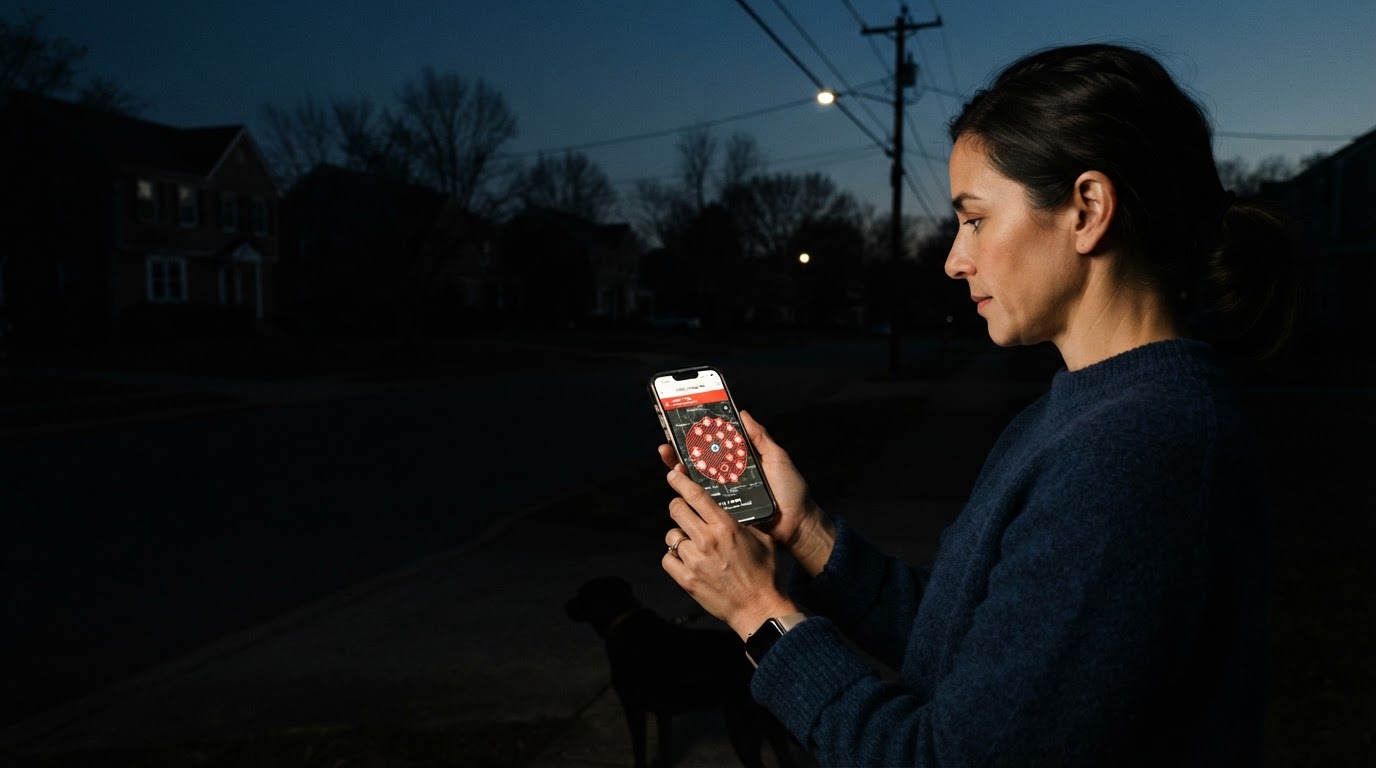
FEMA classifies power outages as momentary, sustained, or extended. Momentary interruptions clear in seconds or minutes and do most of the work for you. Sustained outages last hours to a couple of days and are the ones most households will actually face. Extended outages, driven by major storms or grid failures, can stretch into a week or more. Your plan should cover the middle case well and be ready to extend into the long one. The Red Cross recommends planning for at least 72 hours without outside support, because that is roughly how long it can take for help to reach every affected block after a widespread event.
The National Weather Service issues alerts for the storms that cause most outages, but the outage itself comes from your utility. Sign up for outage alerts from your electricity provider if they offer them; many send texts with estimated restoration times. A hand-crank or battery NOAA weather radio gives you alerts even when cell towers are congested or your phone battery is dying. Treat alerts as situational awareness, not as permission to act on unverified rumors. Your plan should be the same regardless of the exact cause.
The first hour: protect food, find light, stay calm
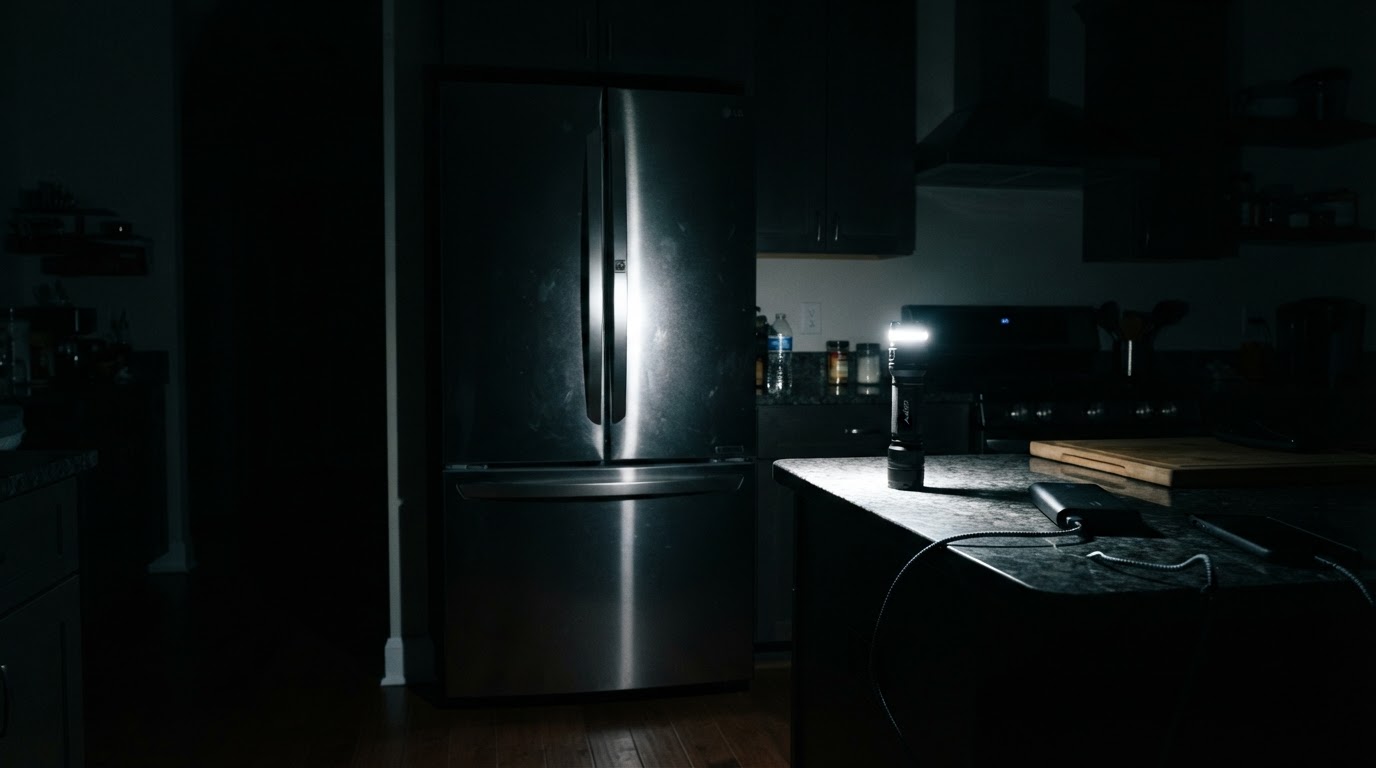
When the lights go out, do not open the refrigerator unless you need to. The FDA is clear: a closed refrigerator keeps food safely cold for about four hours, and a full freezer can hold its temperature for roughly 48 hours (24 hours if half full). Every opening shortens that window. Move quickly to grab what you need, then leave it shut. If you expect the outage to last more than a day, move perishables to the freezer and pack dairy and leftovers together.
Locate your flashlights before you need them by candlelight. Keep at least one per bedroom and one in the kitchen. Battery-powered lanterns light a room far better than a flashlight held in your teeth, and they are far safer than candles, which the Red Cross discourages because of the fire risk. Avoid reopening drawers blindly — keep a charged power bank with your lights so phones stay on for communication. The first hour is also when you make the stay-or-go decision: in a pure power outage, staying is almost always the right call.
Phones, communication, and the offline backup
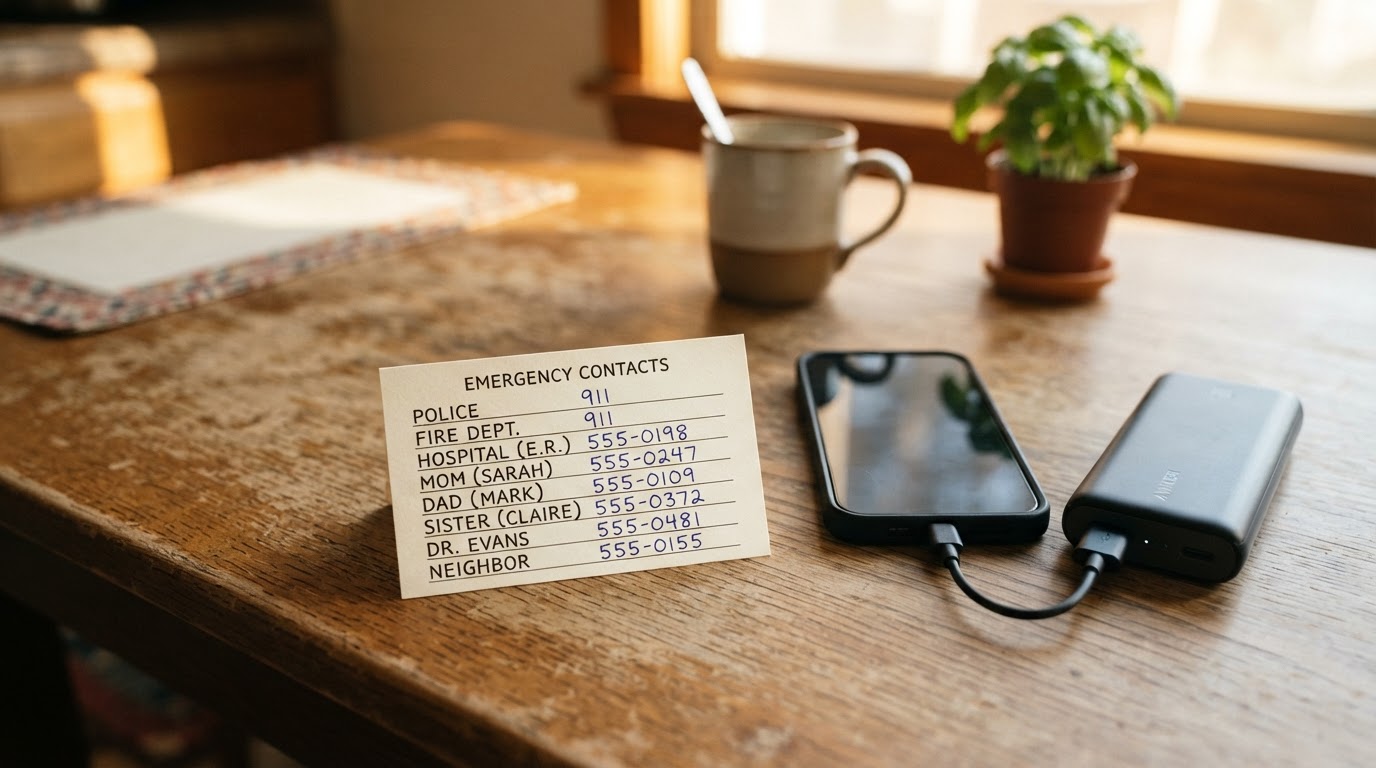
Your phone is your lifeline until its battery dies. Reduce the drain: turn on low-power mode, close background apps, and turn off Wi-Fi searching. Text messages often get through when calls do not, because they use less bandwidth. Keep a printed contact card with your household's important numbers — out-of-area contact, doctor, insurance, a trusted neighbor — because you will not be able to search for them if the phone is dead. The Smart Prepper's communication card is built for this.
If your home internet router has no power, it does not matter whether your provider is up. Keep a written list of your utility's outage hotline. If anyone in the household uses medical equipment that requires power — a CPAP, oxygen concentrator, refrigerated medication — register with your utility's medical baseline or life-support program now, not during the outage. Those programs can prioritize your home for restoration and may notify you in advance.
Heating and cooling when the HVAC stops
When the power goes, so does central heat and air. In cold weather, gather the household into one room and close doors to shrink the space you are trying to warm. Layer clothing and blankets. Never use a gas stove, oven, grill, or camping stove for indoor heat — the Consumer Product Safety Commission warns that these cause carbon-monoxide poisoning, which can be fatal. If you use a generator, run it outdoors and far from windows. Install and test battery-operated carbon-monoxide alarms; they save lives in exactly these scenarios.
In extreme heat, the risk flips: a closed house can become dangerously hot. Open windows at night and close them in the morning with shades drawn. Stay hydrated and check on neighbors, especially older adults. A few hours without air conditioning is uncomfortable; days without it can be dangerous for vulnerable people. If anyone shows signs of heat illness or hypothermia, call 911 rather than waiting it out.
When the outage becomes extended
If the outage stretches past a day, your plan extends. Move refrigerated perishables to a cooler with ice if you can get it, and use a thermometer to confirm the food stays below 40°F. Discard anything that has been above 40°F for more than two hours — the FDA's rule is not flexible, and food poisoning during an outage is the last complication you want. Charge the power bank in your car if the car has gas, and keep the gas tank above half during storm season. If you rely on a portable power station, know its watt-hours and which devices it can actually run, and do not expect it to power a refrigerator for a full day.
Extended outages are when a small amount of redundancy pays off: a second way to charge devices, a second way to light a room, a backup water supply if your well pump needs power. You do not need to prepare for every scenario at once — you need enough overlap that one failure does not cascade into many.
Practical priorities
- Keep flashlights and a power bank where you can find them in the dark
- Keep the refrigerator and freezer closed to protect food
- Never use fuel-burning equipment indoors; test carbon-monoxide alarms
- Keep a printed contact card and your utility's outage hotline
- Register life-support equipment with your utility before an outage
Common mistakes
- Opening the fridge repeatedly 'just to check'
- Using a gas oven or grill to heat a room
- Running a portable generator indoors or near a window
- Draining a phone searching for signal instead of texting
- Assuming the utility will call you when power is restored
Blackout readiness checklist
- Flashlight per bedroom + one in the kitchen
- Battery lantern for the main room
- Power bank charged and accessible
- NOAA weather radio (battery or hand-crank)
- Printed contact card with utility hotline
- Carbon-monoxide alarm with fresh batteries
- Extra batteries sorted by size
- Cooler and ice or ice packs ready
- Car gas tank above half during storm season
- Life-support devices registered with utility
Sources & further reading
This is planning guidance, not emergency advice. In an emergency, call 911. See a mistake? Report it.