
Browse by topic
Home readiness: harden the place you live
Fire safety, leak detection, flood mitigation, document protection, lawful security, backup utilities, renter needs, and maintenance — protect your home before the event.
A home readiness plan is mostly maintenance — the unglamorous work that doubles as preparation and keeps a small problem from becoming a disaster.
House fire
Most common disaster
Test smoke alarms
First step
Two escape routes
Key tool
Renter insurance + kit
For renters
Fire safety is the foundation
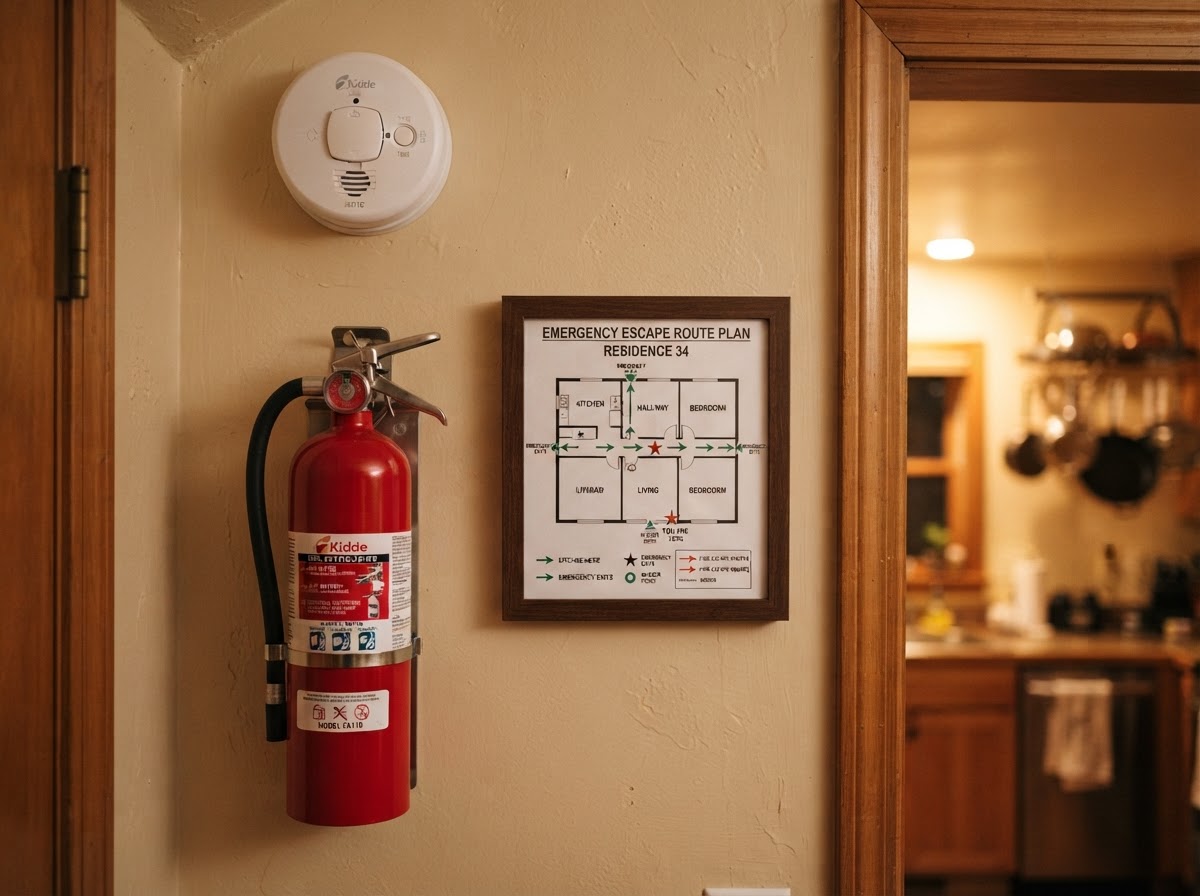
A house fire is the most common disaster a household will face, and the planning is straightforward but often skipped. Ready.gov and the NFPA recommend working smoke alarms in every bedroom, outside every sleeping area, and on every level — interconnected, so that when one sounds they all sound. Test them monthly by pressing the test button, replace the batteries at least once a year, and replace the alarm itself every ten years. The CDC notes that working smoke alarms cut the risk of dying in a home fire roughly in half. The alarm is the first line of defense, and the plan starts with making sure they work.
Plan two ways out of every room — usually the door and a window — and choose an outside meeting place. Keep a fire extinguisher in the kitchen and know how to use it, but only on small, contained fires. Never go back inside for a person or a pet; tell firefighters, who have the gear. Run a fire drill at least twice a year, day and night, because most fire deaths happen at night when people are asleep. The Smart Prepper's house fire guide walks through the full plan. The fire plan is the alarms, the routes, the meeting place, the drill, and the habits that prevent fires before they start — and most of it is free.
Leak detection and water damage
Water damage is one of the most common and costly household problems, and much of it is preventable. Know where your main water shut-off is and how to turn it off, because minutes matter once a pipe splits. Insulate pipes along exterior walls and in unheated spaces, and let faucets drip during extreme cold to prevent freezing. A frozen pipe that bursts is one of the most expensive winter failures a home can have. A water leak sensor near the water heater, under sinks, and in the basement is a cheap early-warning tool that can prevent thousands in damage.
If you live in a flood-prone area, the home readiness plan extends: install check valves in plumbing to stop sewage backup, raise electrical outlets and the furnace above your expected flood level, and move valuables and electronics off the basement floor. A sump pump with a battery backup is one of the highest-value investments in a flood-prone home, because most sump pumps fail exactly when the power that runs them is out. The home readiness page is where you turn the general flood guidance into the specific steps for your home — and the Smart Prepper's flood guide covers it in detail.
Protect your documents
The documents that prove who you are and what you own are the documents you need most after a disaster — and the ones most at risk from fire, water, and displacement. Keep originals in a fireproof and waterproof safe or a safe deposit box, and keep digital copies in secure cloud storage and on an encrypted USB drive. The documents to protect: identification, insurance policies, deeds, wills, passports, and financial records. Keep a written list of your accounts, policy numbers, and the phone numbers to report a loss. If your home is damaged or you are displaced, the documents are how you prove who you are and what you own.
Keep an inventory of your belongings with photos and serial numbers for insurance, and update it each year. The FTC recommends this for identity recovery too, because the list of what you own is the list of what you can claim. The home readiness plan includes the document plan, because the documents are the recovery — without them, the insurance claim, the FEMA application, and the rebuilding all stall. The Smart Prepper's document protection guide walks through what to keep, where to keep it, and how to back it up. The fundamentals are the fire plan, the water plan, and the document plan — and all three protect the home from the inside out.
Backup utilities and maintenance
Home readiness is mostly maintenance. Have your heating system serviced and your chimney inspected each year, because a blocked flue sends carbon monoxide into the home. Keep gutters cleared so water can drain. Trim branches that overhang the roof. Check the roof for loose shingles. Keep the foundation vented and the basement dry. None of this is exotic — it is the maintenance that doubles as preparation, and most of it has nothing to do with a disaster at all. The home that is maintained is the home that survives a storm, a fire, or a flood better than the one that is not.
If you have backup utilities — a generator, a portable power station, a wood stove — test them before you need them. Keep fuel stored safely. Know how to use them, and know their limits. A backup that has not been tested is a backup that fails the first time you need it. The home readiness plan is the maintenance plan, the backup plan, and the document plan — and the Smart Prepper's maintenance planner can schedule the checks. The fundamentals are about keeping the home in the state where a disruption is an inconvenience, not a catastrophe.
Renter needs and lawful security
If you rent, the home readiness plan is different but no less important. Renter's insurance covers your belongings in a fire, theft, or flood — the landlord's insurance covers the building, not your stuff. It is inexpensive and it is the document that lets you recover. Keep an inventory of your belongings with photos, because that is how you prove what you lost. Your kit is smaller — you have less space — but the fundamentals are the same: a go-bag, a first-aid kit, a communication card, and a plan for the disruptions that affect an apartment differently than a house, like a building-wide power outage or a fire in a neighboring unit.
For lawful, nonviolent security, the plan is about deterrence and awareness, not armament. Good locks, good lighting, and knowing your neighbors are the foundations. A home that looks occupied and cared for is less of a target. Keep doors and windows locked, and know who has keys. The home readiness page covers lawful, nonviolent security only — household safety, not tactical preparation. The fundamentals are the fire plan, the water plan, the document plan, the maintenance plan, and the renter's plan — and all of them are about keeping your home in the state where a disruption is manageable, not catastrophic.
Home readiness checklist
- Smoke alarms tested monthly
- Two escape routes per room
- Water shut-off located and labeled
- Fireproof/waterproof document safe
- Renter or homeowners insurance verified
- Seasonal maintenance scheduled
Sources & further reading
This is planning guidance, not emergency advice. In an emergency, call 911. See a mistake? Report it.
Explore other topics
Fundamentals
Household needs, risk prioritization, budgets, and gradual preparation — the foundation everything else builds on.
Water
Storage, containers, rotation, treatment concepts, and filter limitations — how to plan water before the tap stops.
Food
Ordinary pantry planning, dietary needs, rotation, shelf-stable foods, and cooking contingencies — food preparedness without the panic.
Medical Readiness
First-aid kits, training, sanitation, prescription continuity with clinicians, and medication storage — health preparedness done right.
Power & Light
Batteries, portable stations, solar, generators, charging, refrigeration, lighting, and carbon-monoxide prevention — power preparedness safely.