
Browse by topic
Kits & bags: build around your real needs
Bug-out, get-home, everyday carry, vehicle, family, pet, apartment, senior, and workplace kits — a kit built for your household, not a generic list.
A kit is not a purchase; it is a plan you can carry. Build it around your household, keep it where you can grab it, and practice with it.
72-hour / go-bag
Core kit
By the door or in car
Location
You must be able to carry it
Key rule
Check every 6 months
Maintenance
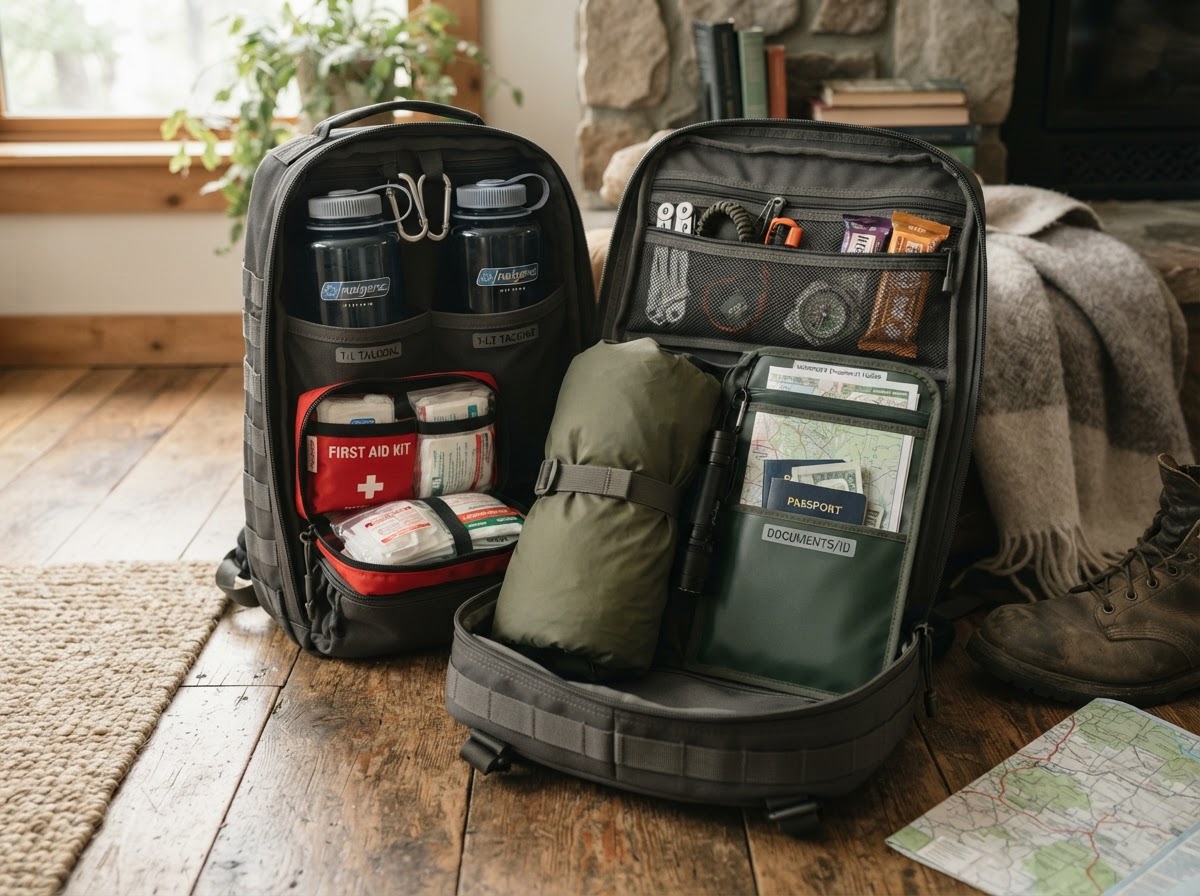
The go-bag you can actually carry
The go-bag is the foundation of the kits plan, and the Red Cross recommends one per person. It should contain a three-day supply of water (one gallon per person per day) and non-perishable food, a first-aid kit, a flashlight and batteries, a NOAA radio, a phone charger and power bank, and a change of clothes. Add copies of important documents — identification, insurance, deeds, medical information — in a waterproof container, plus some cash in small bills, because ATMs and card readers may be down. Keep prescription medications in the bag or keep a list of what to grab. The Smart Prepper's kit builder helps you build one around your household.
The most important rule is that you must be able to carry it. A go-bag that weighs sixty pounds is not a go-bag; it is a storage problem. The Red Cross recommends a backpack, not a box, because you may need to walk. Tailor the bag to the household: infants need formula and diapers; people with accessibility needs may need extra batteries for medical devices; pets need food, water, leashes, carriers, and vaccination records. Keep the bag by the door or in the car so it is the first thing you grab, not the twentieth. The point is that the bag is packed before the evacuation order, not assembled during it.
The get-home bag for commuters
A get-home bag is the kit you keep at the office or in your car for the day a disruption strands you away from home. It is smaller than a go-bag and focused on getting you home: comfortable walking shoes, water, snacks, a phone charger, a map of your commute, cash, a small first-aid kit, and a reflective vest if you might walk along roads. If a transit outage or a storm leaves you miles from home, the get-home bag is what turns a stranded commuter into a walking one. The Smart Prepper's get-home guide covers this in detail.
Keep it in your car or at your desk, not at home — the whole point is that it is with you when you are away. Check it seasonally: swap the shoes if your size changes, refresh the water and snacks, update the map. The get-home bag is the kit for the most common disruption — the one that happens while you are at work — and it is the kit most people forget. The kits plan is not just the go-bag; it is the go-bag for evacuation, the get-home bag for commuting, and the everyday carry for the small disruptions that happen every week.
Everyday carry without the clutter
Everyday carry (EDC) is the set of small tools you keep on your person every day — a pocket knife or multi-tool, a small flashlight, a lighter, a pen, and perhaps a compact first-aid kit. The goal is not to carry a survival kit; it is to have the tools for the small problems that happen daily — a package to open, a dark stairwell, a minor cut. EDC is the lightest tier of the kits plan, and it is the one that gets used most. The Smart Prepper's EDC guide keeps it practical, not tactical.
Keep EDC minimal and legal. A multi-tool with a blade under local length limits, a small flashlight, and a lighter is enough for most people. Do not carry anything that is illegal in your area or that you are not trained to use. EDC is about solving small problems, not preparing for a tactical scenario. The fundamentals are the go-bag for evacuation, the get-home bag for commuting, the EDC for daily life — and each one is built around the real needs of your household, not a generic list from a survival store.
Vehicle, pet, and household-specific kits
A vehicle kit covers the breakdown that happens on the road: jumper cables, a tire gauge and patch kit, water and shelf-stable snacks, a flashlight, a first-aid kit, a phone charger, and warm blankets in winter. Add a tow strap, reflective triangles, and a compact shovel if you drive in remote areas. The vehicle kit is the kit for the most likely disruption — a breakdown — and it is the one that sits in the car all year. Check it seasonally: the water and snacks need refreshing, and the blankets are only useful if they are in the car before the winter storm.
A pet kit covers the evacuation that includes animals: food for three-plus days, water, vet records and medications, a leash and carrier, a photo of you with your pet for identification, and waste bags. Keep it by the go-bag so you grab both. The Smart Prepper's pet evacuation guide walks through it. For a household with seniors, add the specific supplies they need — extra medication, a hearing aid battery, a mobility aid backup. For an apartment, the kit is smaller and focused on the constraints of storage and stairs. The kits plan is not one kit; it is a set of kits, each built for a specific person, place, and risk.
Maintain and practice with your kits
A kit is not a one-time purchase; it is a habit. Check every kit every six months: rotate the water and food, replace expired medications, test the flashlight batteries, update the documents and the contact card. A kit that is five years old is a kit that has expired supplies and dead batteries. The maintenance is the plan — without it, the kit is a false sense of security. The Smart Prepper's maintenance planner can schedule the kit checks and export them to your calendar.
Practice with your kits. Grab the go-bag and walk for ten minutes — can you carry it? Open it in the dark — can you find the flashlight? If you have children, have them practice grabbing their bags. The kit that is practiced is the kit that works in an evacuation. The kit that is not is the kit that fails. The fundamentals of the kits plan are the go-bag, the get-home bag, the EDC, the vehicle and pet kits, the maintenance, and the practice — and all of them are built around your household, not a generic checklist.
Kits & bags checklist
- Go-bag packed per person
- 3-day water + food in each bag
- Documents in a waterproof container
- Get-home bag in the car or desk
- Vehicle kit stocked
- Pet kit packed (if applicable)
Sources & further reading
This is planning guidance, not emergency advice. In an emergency, call 911. See a mistake? Report it.
Explore other topics
Fundamentals
Household needs, risk prioritization, budgets, and gradual preparation — the foundation everything else builds on.
Water
Storage, containers, rotation, treatment concepts, and filter limitations — how to plan water before the tap stops.
Food
Ordinary pantry planning, dietary needs, rotation, shelf-stable foods, and cooking contingencies — food preparedness without the panic.
Medical Readiness
First-aid kits, training, sanitation, prescription continuity with clinicians, and medication storage — health preparedness done right.
Power & Light
Batteries, portable stations, solar, generators, charging, refrigeration, lighting, and carbon-monoxide prevention — power preparedness safely.