Browse by topic
Medical readiness: kits, training, and continuity
First-aid kits, training, sanitation, prescription continuity with clinicians, and medication storage — health preparedness done right.
A medical plan is not a first-aid kit in a drawer. It is the training to use it, the medication to stay well, and the clinician relationship to guide both.
Take a class
First skill
7-day minimum
Meds buffer
Known to all
Kit location
Your clinician
Key contact
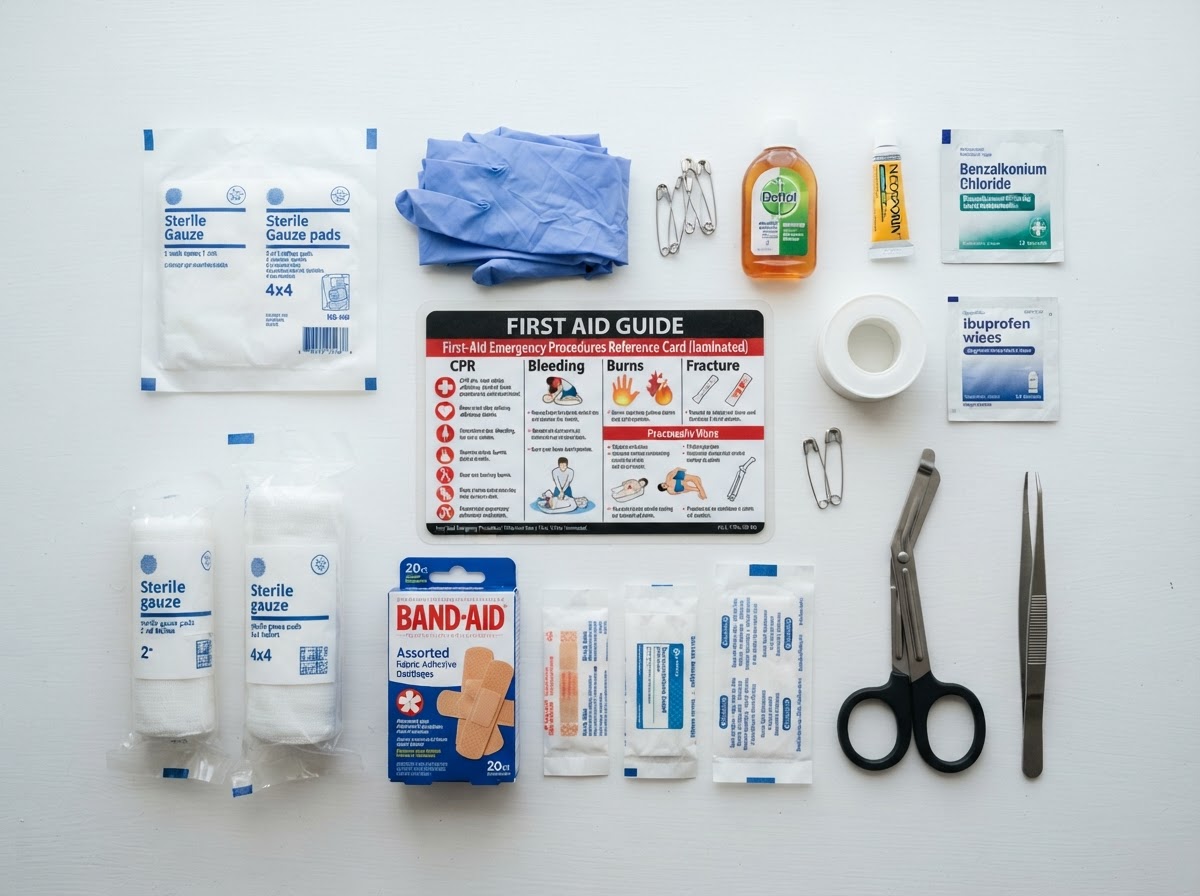
Build a first-aid kit that fits your household
A first-aid kit is the most visible part of medical readiness, and it is the one most people get wrong by buying a prepackaged kit and calling it done. The Red Cross recommends a kit that includes adhesive bandages in assorted sizes, gauze and tape, scissors and tweezers, disposable gloves, antiseptic, a thermometer, a first-aid reference guide, and pain relievers. But the kit that fits a household with children is different from one for a household with seniors, and one for a household with a chronic condition is different still. Build your kit around your household, then customize it.
Add the supplies your household is likely to need: a triangle bandage for a sling, an instant cold pack, a burn dressing if anyone cooks, hydrocortisone for reactions, and any over-the-counter medications your household uses regularly. If anyone takes prescription medication, keep a seven-day buffer in the kit or a list of what to grab. Keep the kit in a location every household member knows — not buried in a closet. The Smart Prepper's first-aid kit guide walks through every item with the reason behind it.
Check the kit every six months. Replace anything expired, restock anything used, and update it as the household changes. A first-aid kit that is five years old is a kit that has expired medications and missing supplies. The kit is not the plan; the kit plus the training plus the maintenance is the plan. A well-stocked kit that no one knows how to use is a box; a well-stocked kit that someone has practiced with is a tool.
Get the training to use it
A first-aid kit without training is a box of supplies; a kit with training is a lifesaving tool. The Red Cross and the American Heart Association offer CPR and first-aid courses in most communities, and many are a single day. Take one. Learn how to stop bleeding, how to do CPR, how to use an AED if one is available, and how to recognize the signs of a stroke or heart attack. The training is the difference between a household that can respond and one that watches. The Smart Prepper's training guide helps you find a local course.
If you have children, take a pediatric first-aid course — the techniques for a child are different from an adult, and the emergencies are different. If anyone in the household has a chronic condition, learn the specific emergency response for it: how to use a glucagon kit, how to use an epinephrine auto-injector, how to respond to a seizure. The training is not generic; it is specific to your household's risks. The fundamentals of medical readiness are the kit, the training, and the household-specific knowledge that ties them together.
Refresh the training every two years — the certifications expire, and the guidelines change. Keep a reference guide in the kit, because in a crisis you will not remember everything. The Red Cross first-aid app is a useful backup, but only if your phone has charge. A printed reference in the kit is the fallback that never needs a battery. The training plus the reference is the plan that works when the power is out and the phone is dead.
Plan medication continuity with your clinician
The CDC recommends keeping at least a seven-day supply of prescription medications, and talking to your clinician about extending that buffer for essential drugs. Do not wait until a disruption to have this conversation — call your clinician now, explain that you are building a household preparedness plan, and ask about a refill schedule that lets you keep a buffer. Some insurance plans limit early refills, so the conversation may take persistence. The point is to have the medication before the pharmacy is closed or the supply is disrupted.
Keep a written list of your medications — the name, the dose, the prescriber, and the pharmacy — with your emergency contacts. In a crisis, you may not have your phone, and you may not remember the details. The list is how a stranger or a family member can help you. If any medication requires refrigeration, plan for a power outage: know how long it stays safe at room temperature (ask your pharmacist) and keep a cooler with ice or ice packs ready. The CDC notes that some insulin and liquid antibiotics degrade quickly without refrigeration, and the guidance varies by medication.
If you use medical equipment at home — oxygen, a nebulizer, a CPAP, a glucose monitor — confirm you have supplies to last through a disruption and a backup plan if the equipment fails. Register life-support equipment with your utility's medical baseline program, which can prioritize your home for power restoration and may notify you in advance of outages. The medical plan is not just the kit and the medication; it is the relationship with your care team and the backup for the equipment you depend on. The Smart Prepper's medication continuity guide walks through this step by step.
Sanitation and infection prevention
Medical readiness includes sanitation, because the disruption that cuts power or water can also spread disease. Keep hand sanitizer, soap, and a supply of cleaning products. If the water stops, plan for how you will wash hands — the CDC recommends using bottled water with soap, or hand sanitizer with at least 60 percent alcohol. Plan for waste if the toilet cannot flush: a bucket with a lid and trash bags, with cat litter or sawdust to reduce odor. The sanitation plan is part of the medical plan, because poor sanitation during a disruption is how a power outage becomes a gastroenteritis outbreak.
If anyone in the household is immunocompromised, the sanitation plan is more stringent — more hand washing, more surface cleaning, and a lower threshold for seeking care. Keep a supply of the specific cleaning products your household uses, because a disruption is the worst time to discover you are out of the one product that works. The medical plan is the kit, the training, the medication continuity, the sanitation, and the knowledge of when to call for help — and all of them are specific to your household.
Know when to call for help
A first-aid kit and training do not make you a doctor. Know the signs that mean call 911: chest pain, difficulty breathing, severe bleeding, a suspected stroke (FAST signs), a severe allergic reaction, or any condition that is beyond your training. The plan is to stabilize and call, not to treat. Keep your emergency contacts and your clinician's number on a printed card, because you will not be able to look them up if the phone is dead. The Smart Prepper's communication card is built for this.
The fundamentals of medical readiness are the kit, the training, the medication continuity, the sanitation, and the knowledge of when to call for help. None of them are complicated; all of them require doing, not just buying. The household that has a kit, has practiced with it, has a medication buffer, has a sanitation plan, and knows when to call 911 is a household that can handle the medical side of a disruption. The household that has only a kit in a drawer is a household that will struggle. The medical page is where you build the first kind.
Medical readiness checklist
- First-aid kit built and customized
- CPR / first-aid training current
- 7-day medication buffer secured
- Written medication list with contacts
- Hand sanitizer and sanitation supplies
- Clinician consulted on continuity plan
Sources & further reading
This is planning guidance, not emergency advice. In an emergency, call 911. See a mistake? Report it.
Explore other topics
Fundamentals
Household needs, risk prioritization, budgets, and gradual preparation — the foundation everything else builds on.
Water
Storage, containers, rotation, treatment concepts, and filter limitations — how to plan water before the tap stops.
Food
Ordinary pantry planning, dietary needs, rotation, shelf-stable foods, and cooking contingencies — food preparedness without the panic.
Power & Light
Batteries, portable stations, solar, generators, charging, refrigeration, lighting, and carbon-monoxide prevention — power preparedness safely.
Communication
Weather alerts, radios, satellite messaging, family plans, maps, offline information, and reunification — a communication plan that does not depend on one app.