
Browse by topic
Power & light: keeping the lights on
Batteries, portable stations, solar, generators, charging, refrigeration, lighting, and carbon-monoxide prevention — power preparedness safely.
A power plan is less about wattage than about safety — knowing what to run, what not to run indoors, and how to keep the lights on without the CO risk.
Carbon monoxide
Biggest risk
Flashlights + batteries
First buy
Watt-hours, not watts
Key spec
Never run a generator indoors
Rule
Start with lighting you can find in the dark
The first power preparedness purchase is not a generator; it is a flashlight per bedroom and a battery-powered lantern for the main room. Keep them where you can find them in the dark — in a nightstand, not a basement. The Red Cross discourages candles because of the fire risk, and a flashlight is safer, brighter, and reusable. Add a headlamp for hands-free light — for cooking, for reading, for finding the shutoffs. Keep extra batteries sorted by size, and check them annually. The Smart Prepper's lighting guide compares lanterns, headlamps, and flashlights.
A battery-powered lantern lights a room far better than a flashlight held in your teeth, and it is the tool that makes the first hour of an outage manageable. Keep one in the kitchen and one in the living area. A hand-crank or solar lantern is a useful backup that never needs batteries, but it is not as bright as a battery model. The lighting plan is the foundation of the power plan, because the first thing an outage takes is the ability to see. Light first, power second.
Keep a power bank with your lights so phones stay on for communication. A 10,000 mAh bank charges a phone two to three times, and it is the tool that keeps you connected when the grid is down. Charge it before the outage if you have warning, and keep a car charger as a backup — your car is a generator if you have fuel. The lighting and phone plan is the part of the power plan that matters in the first hour, and it is the part most people already have the tools for.
Understand portable power stations
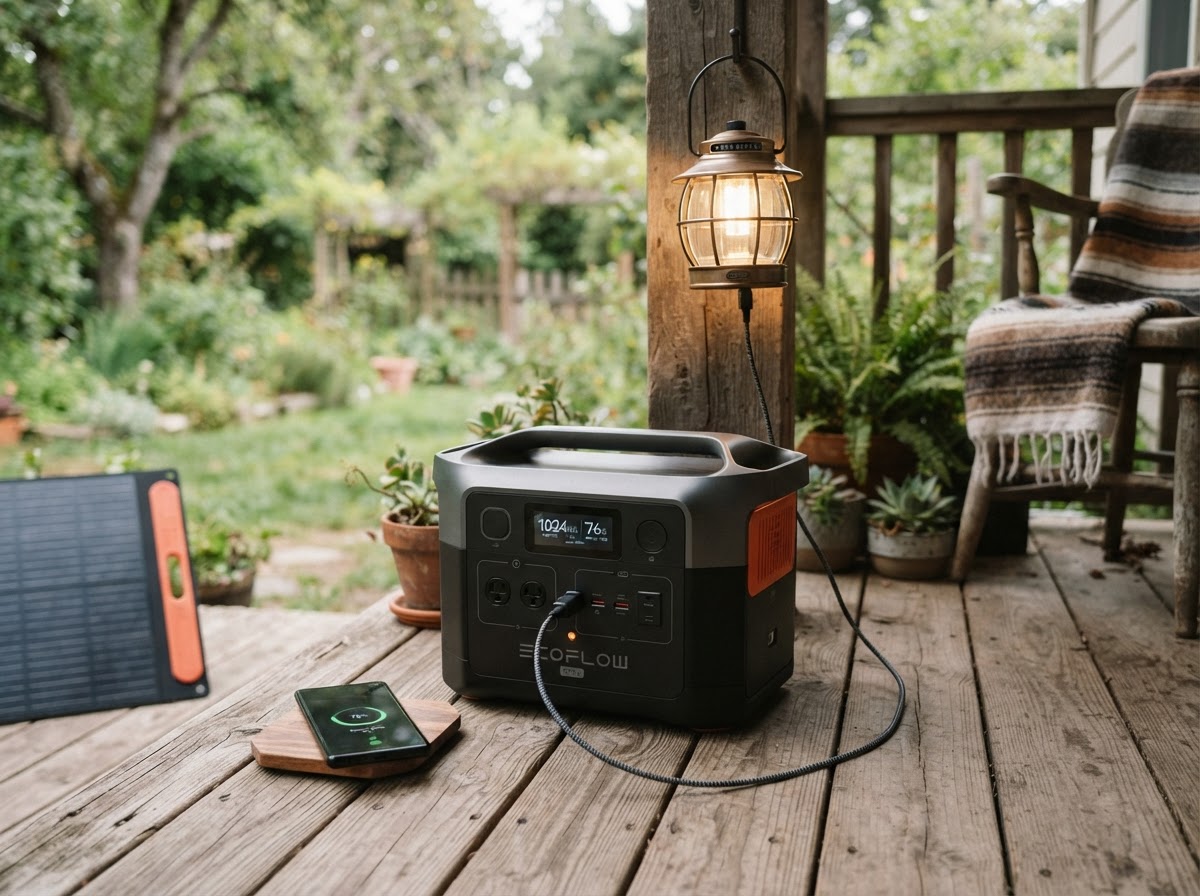
A portable power station is a battery with outlets — it can run a phone, a light, a CPAP, or a small fan for hours, but it will not run a refrigerator or a heater. The key specification is watt-hours (Wh), not watts. A 500 Wh station can run a 50 W device for about 10 hours (minus efficiency losses). Know the wattage of the devices you want to run — a phone charger is 10 W, a CPAP is 50-80 W, a mini fridge is 100-200 W at startup — and calculate whether the station covers your needs. The Smart Prepper's backup power planner does this calculation for you.
Distinguish surge from continuous. A device that needs a surge to start — a refrigerator compressor, a motor — may need two to three times its running wattage for a few seconds. A power station that cannot handle the surge will shut off even if it can handle the continuous load. Check the station's surge rating before you buy. Most stations list both a continuous and a surge wattage. The mistake is buying on watts alone; the right buy is based on watt-hours, surge capacity, and the devices you actually need to run.
Keep the station charged and check it every few months — lithium batteries slowly discharge. Most stations have a battery level display. If you have a solar panel, the station can recharge during a long outage, but a small panel may take a full day to recharge a large station. Match the panel to the station: a 100 W panel is a reasonable pairing for a 500 Wh station. The power station is the middle tier of the power plan — it covers the hours-long outage, the medical device, and the communication need. It does not cover the days-long outage or the heating need.
Generators: placement and safety first
A generator is the tool for a days-long outage, but it is also the most dangerous item in a power plan. The Consumer Product Safety Commission warns that carbon monoxide from generators kills dozens of people every year — they run them in a garage, on a porch, or near a window, and the CO kills them in their sleep. Never run a generator indoors, in a garage, or within 20 feet of a window, door, or vent. Run it outdoors, on a dry surface, with the exhaust pointed away from the home. Install and test battery-operated carbon-monoxide alarms on every level of the home — they save lives in exactly these scenarios.
Size the generator to the load. A small inverter generator (2,000 W) runs a refrigerator, some lights, and a few devices. A larger portable (5,000-7,000 W) can run more, but it is louder and uses more fuel. A standby generator, installed permanently and connected to the home's electrical panel, is the top tier — it starts automatically and can run a whole house, but it costs thousands and requires professional installation and a fuel supply. The Smart Prepper's generator guide walks through sizing, fuel, and safety. The generator plan starts with safety, because a generator used wrong is more dangerous than no generator at all.
Store fuel safely and rotate it — gasoline with ethanol degrades in a few months. Add a fuel stabilizer if you store it longer, and keep it in an approved container away from the home. Keep a supply for the generator, but do not over-stock — a garage full of gasoline is a fire hazard. The generator plan is the fuel plan, the safety plan, and the maintenance plan. Test the generator annually, and never backfeed your home's wiring by plugging a generator into an outlet — use a transfer switch or plug devices directly into the generator. The CPSC warns that backfeeding is both illegal and lethal to utility workers.
Solar: realistic expectations
A portable solar panel can recharge a power station during a long outage, but it is not a replacement for the grid. A 100 W panel in full sun produces about 400-500 Wh in a day — enough to recharge a phone several times or top up a small station. In cloudy weather, the output drops to a fraction. Solar works best as a complement to a power station, not as a standalone source. If you rely on solar, know your local sun hours and size the panel to your need. The Smart Prepper's solar guide sets realistic expectations.
For a household considering rooftop solar, the preparedness value depends on whether you have battery backup — without it, a grid-tied solar system shuts off when the grid goes down, even if the sun is shining. A battery-backed solar system can power the home during an outage, but it is a significant investment. The power plan is tiered: lighting and phones first, a power station for hours-long needs, a generator for days-long needs, and solar as a complement. The fundamentals are about building the right tier for your risk, not the biggest tier you can afford.
Refrigeration and food safety during an outage
The FDA is clear: a closed refrigerator keeps food safely cold for about four hours, and a full freezer can hold its temperature for roughly 48 hours (24 hours if half full). Every opening shortens that window. Keep a thermometer in the fridge and freezer — if the food has been above 40°F for more than two hours, throw it out. The FDA's rule is not flexible, and food poisoning during an outage is the last complication you want. If you expect a long outage, move perishables to the freezer and pack dairy and leftovers together to share the cold.
If you have a generator or a large power station, you can run the refrigerator intermittently — a few hours on, a few off — to extend the safe window. But do not assume the power plan covers the food plan; they are separate, and both need attention. The power plan is the lighting, the phone, the medical device, the refrigerator, and the safety to run it all without creating a new emergency. The fundamentals are the tiered build: light first, then phones, then the medical device, then the refrigerator, then the whole house — in that order, and with safety at every step.
Power & light checklist
- Flashlight per bedroom + lantern for main room
- Power bank charged and accessible
- Carbon-monoxide alarms tested
- Power station sized to your devices
- Generator run outdoors, 20 ft from windows
- Fuel stored safely with stabilizer
Sources & further reading
This is planning guidance, not emergency advice. In an emergency, call 911. See a mistake? Report it.
Explore other topics
Fundamentals
Household needs, risk prioritization, budgets, and gradual preparation — the foundation everything else builds on.
Water
Storage, containers, rotation, treatment concepts, and filter limitations — how to plan water before the tap stops.
Food
Ordinary pantry planning, dietary needs, rotation, shelf-stable foods, and cooking contingencies — food preparedness without the panic.
Medical Readiness
First-aid kits, training, sanitation, prescription continuity with clinicians, and medication storage — health preparedness done right.
Communication
Weather alerts, radios, satellite messaging, family plans, maps, offline information, and reunification — a communication plan that does not depend on one app.