
Research-based buying guide
Portable Solar Panels: Realistic Expectations and Tradeoffs
Solar is a complement, not a free lunch. Match panel watts to what you actually charge.
Portable solar panels recharge batteries when the grid is down, but output depends on sun, weather, angle, and panel quality. Real-world yield is often well below the label rating, sometimes half or less on a cloudy day or with a less-than-ideal angle. This is research-based guidance on what solar realistically delivers, not a hands-on test, so you can match a panel to your needs without overbuying.
Solar makes the most sense as a complement to a power station or a power bank you already own. A panel alone does not store energy; it only produces it when the sun is out. You need somewhere to put the power it generates. Plan your setup as a system: a panel to recharge a battery, and a battery to run your devices when the sun goes down.
Before buying, check your power station's solar input rating in watts and volts. A panel larger than the station's input limit wastes capacity and may not charge faster. Match the panel to the station, not the other way around, and verify the connector, voltage, and polarity before you assume two parts will work together.
Start with Your Situation
Charging a power bank
A folding 50–100 W panel is light and packable.
Recharging a mid-size station
A 200 W panel matched to the station's input rating.
Off-grid or long outages
A larger array with a charge controller and safe wiring.
Useful for this guide
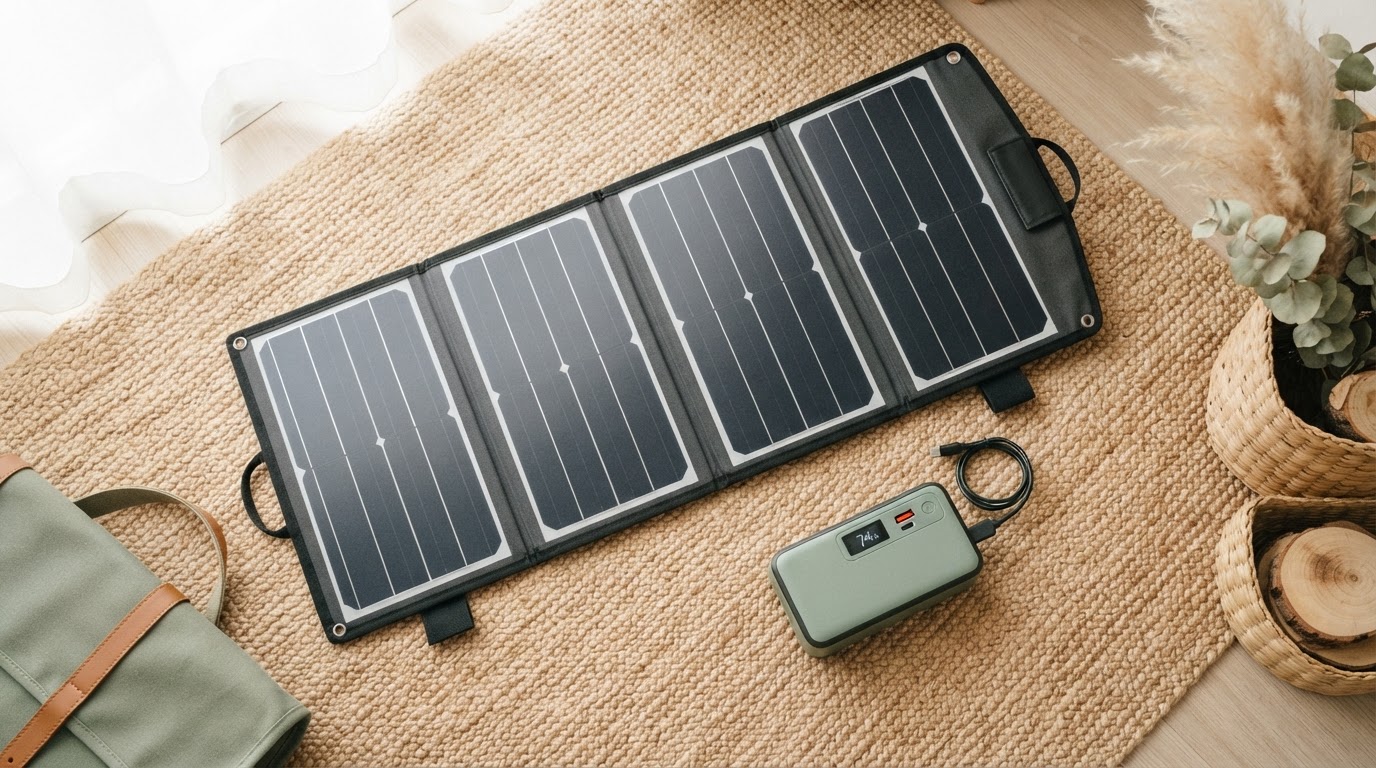
Folding Portable Solar Panel
Lightweight and packable. Verify the connector matches your power bank or station; equal connectors do not guarantee electrical compatibility.
Best for: Recharging a power bank or small station
Compare Your Options
These are product categories, not specific tested models. We do not invent prices, ratings, or stock.
| Type | Best for | Evidence | Key notes |
|---|---|---|---|
| Folding 50–100 W panel | Charging a power bank or small station on the go. | Research-based | Low real-world output. Verify connector compatibility. Needs direct sun |
| Briefcase 200 W panel | Recharging a mid-size power station during an outage. | Research-based | Heavier. Real yield is below the label rating. Needs direct sun and correct angle |
| Rigid 400+ W panel array | Off-grid or long outages with a fixed setup. | Research-based | Not portable. Requires mounting and a charge controller. Needs safe wiring |
Scroll the table horizontally on narrow screens to read every column.
What to Look For
Rated output versus real-world production
Wattage ratings are measured under ideal lab conditions. Real sun, shade, and angle usually produce far less. Plan for a fraction of the label rating, and treat any estimate as optimistic until you test it.
Shade, orientation, weather, and season
Even partial shade cuts output sharply. Panels need direct sun, correct orientation, and clear weather. Winter and high latitudes reduce production further, and a cloudy day can drop output to nearly nothing.
Voltage and current limits
A panel's voltage and current must fall within what your power station or charge controller accepts. Mismatched voltage can damage equipment or simply fail to charge. Check the open-circuit voltage and the input range of the device you plan to charge.
Connector and polarity compatibility
Equal connectors do not guarantee electrical compatibility. Verify voltage, polarity, and the input requirements of the device you are charging before you assume an adapter will work. A matching barrel connector can still carry the wrong voltage.
Power-station input requirements
Most stations cap solar input in watts and volts. A panel larger than the input limit wastes capacity and may not charge faster. Match the panel to the station's documented input rating.
Weight, portability, and weather resistance
Folding panels are portable but lower output; rigid arrays are efficient but need mounting. Check documented weather resistance for outdoor use, since not all portable panels are designed to stay out in rain.
Useful for this guide
Folding Portable Solar Panel
Lightweight and packable. Verify the connector matches your power bank or station; equal connectors do not guarantee electrical compatibility.
Best for: Recharging a power bank or small station
Products Worth Comparing
Folding 50–100 W panel
Charging a power bank or small station on the go.
Advantages
- Lightweight and packable
- Affordable entry
- Good for small devices
Limitations
- Low real-world output
- Verify connector compatibility
- Needs direct sun
Accessories: A compatible cable and a power bank or small station.
Briefcase 200 W panel
Recharging a mid-size power station during an outage.
Advantages
- Higher output than folding panels
- Sturdier
- Often pairs with a matching station
Limitations
- Heavier
- Real yield is below the label rating
- Needs direct sun and correct angle
Accessories: A cable matching the station's input and a stand for orientation.
Rigid 400+ W panel array
Off-grid or long outages with a fixed setup.
Advantages
- Highest output
- Most efficient per watt
- Durable
Limitations
- Not portable
- Requires mounting and a charge controller
- Needs safe wiring
Accessories: A charge controller, mounting hardware, and properly sized cabling.
Common Buying Mistakes
- !Expecting label-rating output in real conditions. Plan for a fraction of it.
- !Assuming equal connectors mean electrical compatibility.
- !Buying a panel larger than the station's input limit.
- !Forgetting that shade, weather, and season dramatically reduce production.
Care and Readiness
- Clean panels gently to remove dust and debris that block sun.
- Store folding panels dry and protected to preserve the fabric and cells.
- Inspect cables and connectors for damage before each use.
- Orient panels directly at the sun and adjust through the day for best output.
Common Questions
Will a 100 W panel charge my station quickly?
Probably not quickly. Real-world output is often well below 100 W, and the station's input limit may cap charging speed further. Treat recharge times as estimates.
Do I need a charge controller?
For a panel charging a battery or station, yes, unless the station has one built in. A controller prevents overcharging and matches voltage safely. Check whether your station regulates solar input itself.
Can I use any panel with my power station?
Only if voltage, current, and connector match the station's input requirements. Equal connectors do not guarantee compatibility, and mismatched voltage can damage the station.
Build Your Household Plan
Add this category to your plan, then work through the essentials at a pace that fits your household.
Explore the 10 EssentialsMore gear guides
Water Filters and Purifiers: What to Buy for Your Situation
Research-based comparison of filter and purifier types, what each removes, and where it falls short.
Portable Power Stations: A Buyer's Guide to Capacity and Output
Match watt-hours to what you actually need to run, and understand the gap between rated and usable energy.
Choosing an Emergency Weather Radio
NOAA reception, SAME county alerting, and power sources compared so you know what you are actually buying.
Emergency Lighting: Lanterns, Headlamps, and Flashlights Compared
Match the light to the job, and prioritize usable runtime over peak brightness.
Sources and Method
This guide compares manufacturer specifications, published documentation, and relevant official guidance. Products are not described as hands-on tested unless testing is documented. This is research-based comparison, not a substitute for manufacturer instructions or professional advice.
Some links on this page are affiliate links. We may earn a commission if you buy through them, at no extra cost to you.