
AI & Cyber Disruption Preparedness
A cyber disruption is an offline and verification plan.
A cyber disruption can come from a ransomware attack, a data breach, a deepfake, or an AI-driven scam, and it takes more with it than people expect. Ready.gov treats cybersecurity as part of emergency planning, and the lesson is that the digital systems we depend on are not guaranteed. This guide covers the offline backups that keep your household functional when the network is not, the verification habits that protect you from deepfakes and scams, and the account security that protects your identity. It addresses AI with evidence and the honest limits of what AI can and cannot do, not with unsupported predictions.
Keep offline backups of what you need
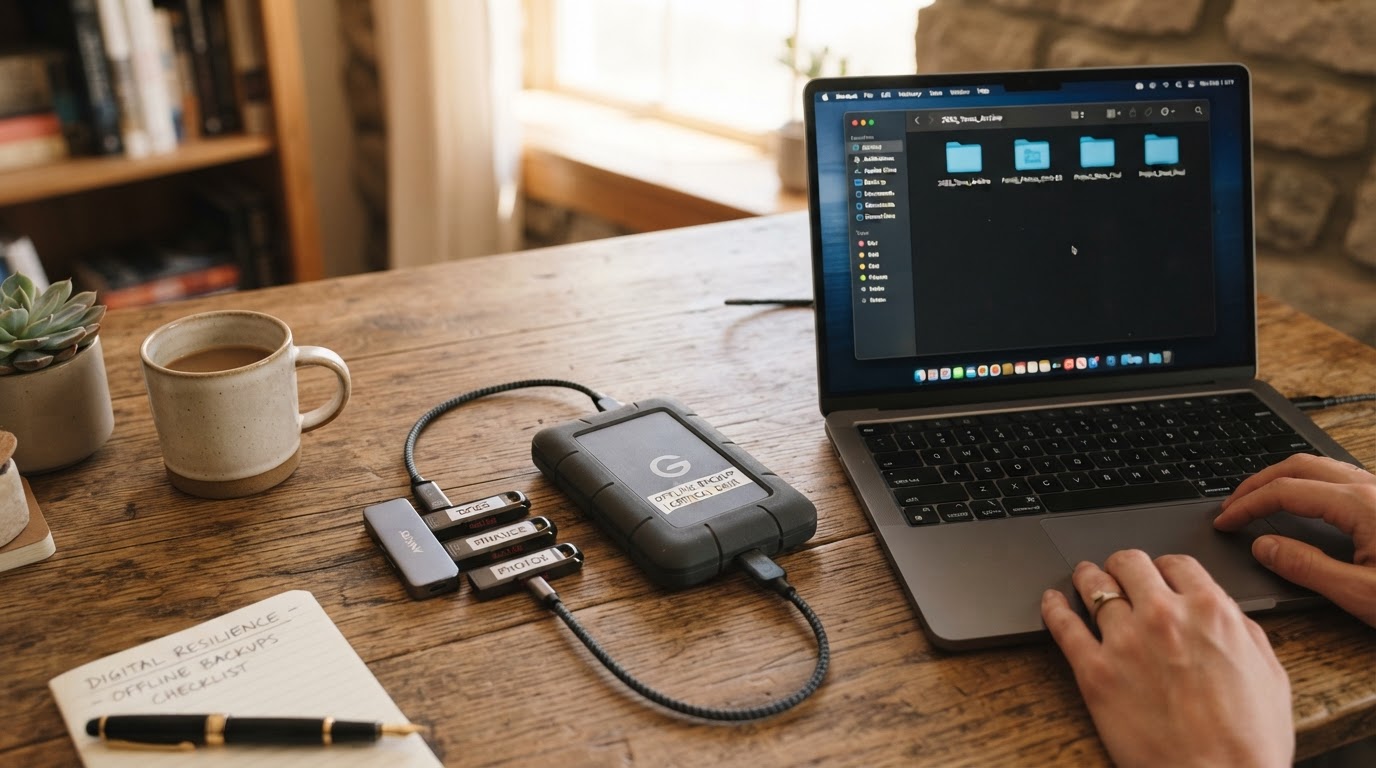
A cyberattack can lock you out of your accounts and your files. Keep offline backups of what you need: important documents, a list of accounts and passwords, and two-factor backup codes. The FTC recommends keeping copies in multiple places — a secure cloud service and an encrypted USB drive stored physically — so that one failure does not lose everything. Keep a printed copy of your most important documents and contact numbers, because if the phone and the computer are both compromised, paper still works.
Keep a written list of your financial accounts, insurance, and the phone numbers to report a loss, because if the apps are down you will need to call. Keep some cash in small bills, because a cyberattack on a bank or a payment processor can take the card readers with it. The plan is to be able to function when the digital systems are not, and the offline backups are the plan.
Protect your accounts and identity
The FTC recommends strong, unique passwords for each account, managed with a password manager, and two-factor authentication on every account that offers it. Keep the two-factor backup codes offline — write them on paper and store them securely — because if your phone is compromised or down, you may not receive a text code. Freeze your credit at the three bureaus, which prevents anyone from opening new accounts in your name; you can freeze and unfreeze it for free. Keep a list of your accounts and how to reach their fraud lines.
Be alert to phishing, because most cyberattacks start with a phishing email or text. Do not click links in unexpected messages, do not open attachments you did not expect, and do not give personal information to unsolicited callers. Verify any request by contacting the organization directly through a known number. The FTC's identity theft recovery steps are the fallback if something is compromised: place a fraud alert, freeze your credit, and report it. The plan is to secure your identity before a crisis and to know how to recover it if one happens.
Verify before you trust: deepfakes and scams

AI can generate convincing voice and video — a deepfake of a family member asking for money, a fake video of a public figure, a scam call that sounds real. The plan is to verify before you trust. If you get an urgent request for money or information from a family member, hang up and call them back on a known number. Agree on a family verification phrase or question that only the real person would know, so a deepfake voice cannot pass. The FTC warns that the urgency is the tell: a real request can wait for you to verify, and a fake one cannot.
Do not act on a video or a voice clip alone, especially if it asks for money or personal information. Verify through a second channel — a phone call, a known email. Be skeptical of anything that creates urgency, because urgency is how scams bypass your judgment. The plan is to slow down and verify, and the verification habit is what protects you from the AI-age scams that are getting more convincing.
Stay informed when the network is down

During a cyber disruption, the network may be congested or down. Keep a battery or hand-crank NOAA weather radio for alerts, because it does not depend on the cell network. Use official sources — Ready.gov, your local emergency management agency, your utility — and verify before you act. Do not rely on social media for emergency information during a disruption, because the disruption may take it with it and misinformation spreads fastest when the usual channels are down.
Keep the phone charged and a power bank ready. Reduce the drain: lower the brightness, close background apps, and turn on low-power mode. Text rather than call when the network is congested, because texts use less bandwidth and often get through. The plan is to stay informed and connected when the network is not, and the radio and the power bank are the backups.
The honest limits of AI
AI can help you plan, but it cannot verify your emergency. An AI assistant can summarize guidance, draft a checklist, or explain a concept, but it cannot confirm whether your specific situation is safe, and it should not be your source for emergency decisions. Use AI for planning and learning, and use official sources and qualified people for verification. The honest limit is that AI is a tool, not an authority, and the plan is to know the difference.
Be skeptical of unsupported predictions about AI — claims that AI will cause a specific collapse, that a specific event is imminent, or that AI can be trusted to make emergency decisions. The plan is to use AI where it helps and to verify where it matters, and the verification is what keeps the household safe. The cyber plan and the AI plan overlap, because the AI age is the age of verification, and the household that verifies is the household that does not get fooled.
Practical priorities
- Keep offline backups of documents, accounts, and 2FA codes
- Use strong unique passwords and freeze your credit
- Verify urgent requests through a known channel
- Keep a battery radio and a power bank ready
- Use AI for planning, official sources for verification
Common mistakes
- Reusing the same password across accounts
- Keeping 2FA backup codes only on the phone
- Acting on an urgent money request without verifying
- Trusting a deepfake voice or video at face value
- Trusting AI to make emergency decisions
AI & cyber disruption readiness checklist
- Offline backups of documents + accounts
- Encrypted USB drive stored physically
- Password manager with unique passwords
- Two-factor with offline backup codes
- Credit frozen at all three bureaus
- Family verification phrase agreed
- Cash in small bills
- Battery or hand-crank radio
- Power bank charged
- List of fraud-line numbers
Sources & further reading
This is planning guidance, not emergency advice. In an emergency, call 911. See a mistake? Report it.