
🤝 Plan the basics
Plan with the people around you
A household plan, a meeting point, an out-of-area contact, and a neighbor you can ask for help — preparedness is a team sport.
Preparedness is often framed as a solo, go-it-alone activity. In practice, the people who do best in a disruption are the ones connected to others — a household that's planned together, a neighbor who checks in, a contact who can relay a message. The plan is the household communication plan, the out-of-area contact, and the neighbor relationships you build before you need them. This page covers the household meeting, the out-of-area contact, and the neighborhood ties that turn isolated prep into community resilience.
The household communication plan
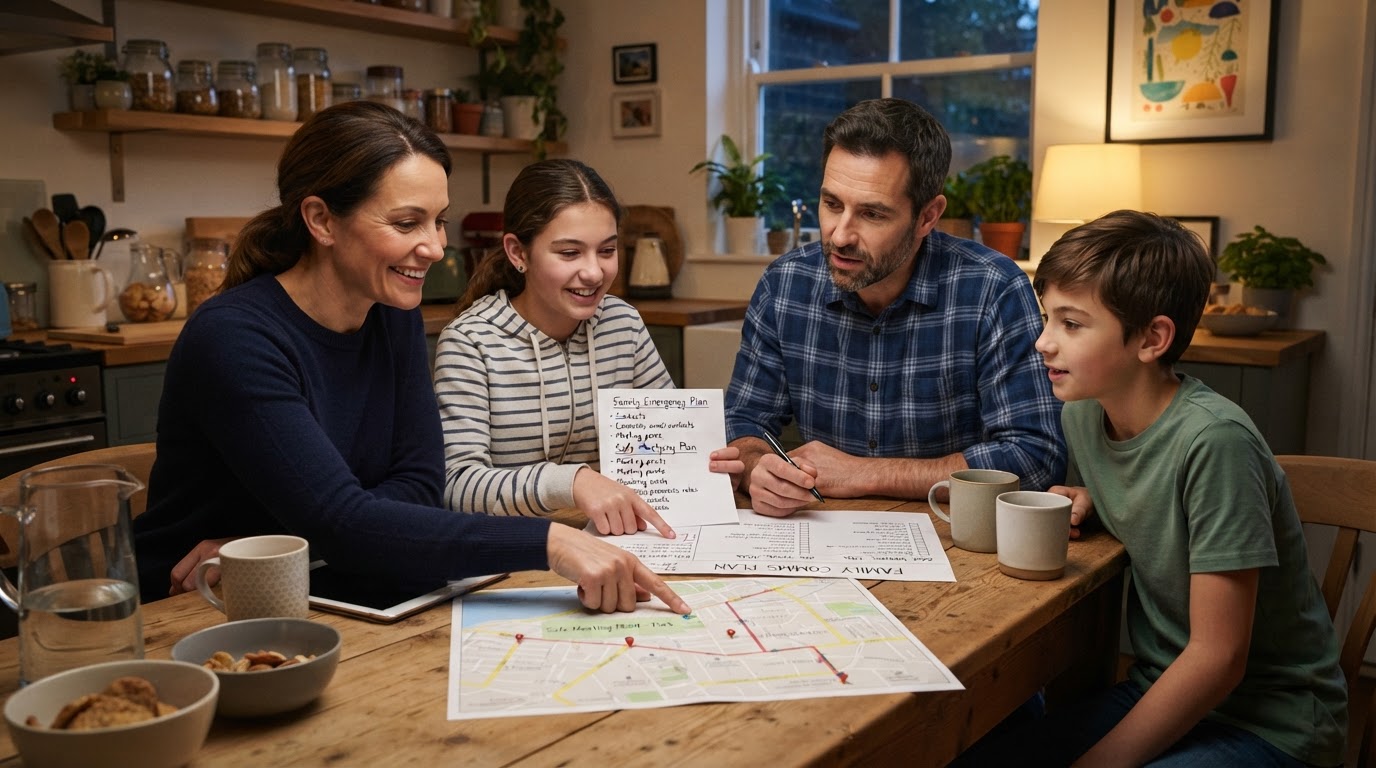
Sit down with the household and decide: where you meet if you're separated and can't get home, who the out-of-area contact is, and how you reach each other if the local network is jammed. Texts often go through when calls don't because they use less bandwidth; agree that you'll text, not call, in a disruption. The family communication plan guide covers this in detail. Ready.gov's make-a-plan page is the reference.
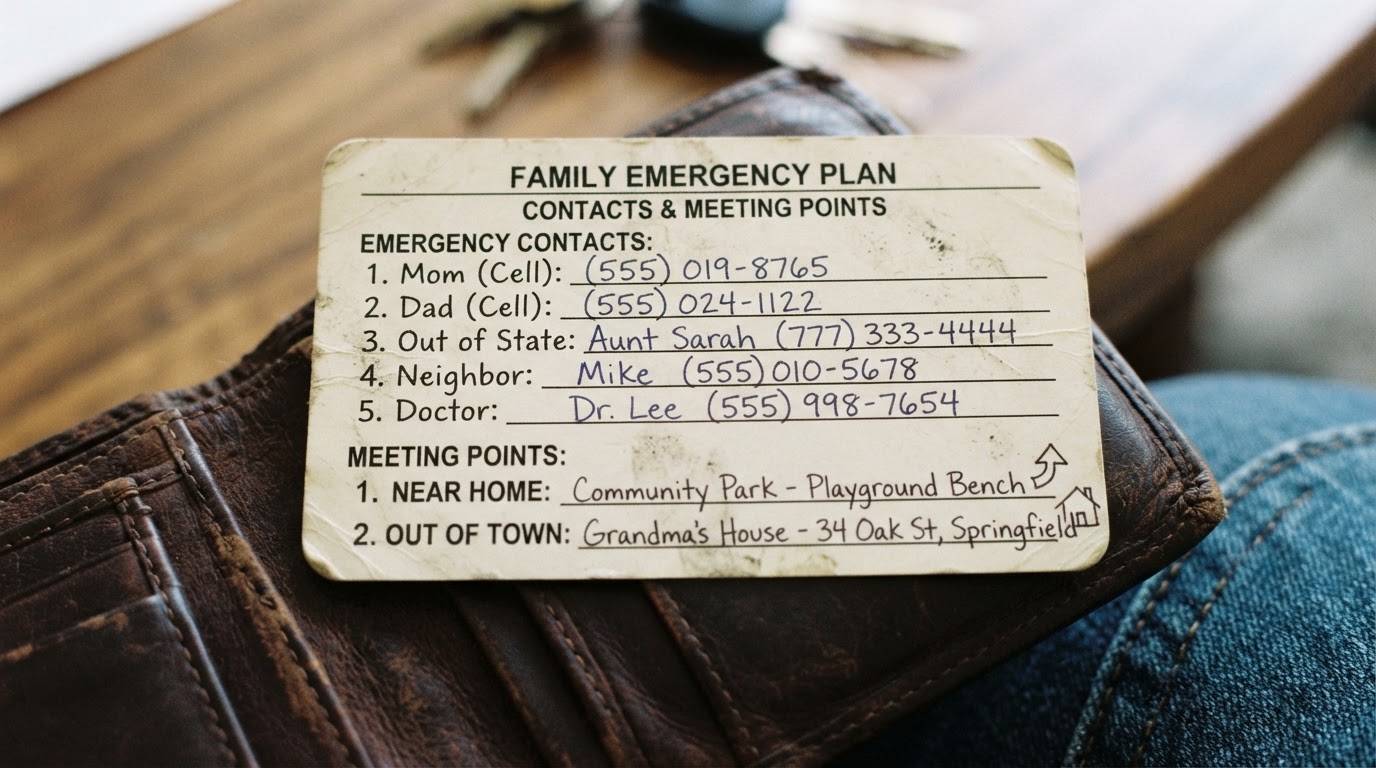
Make sure everyone has the numbers — not just in the phone, but on paper. A phone dies; a card in the wallet doesn't. The household contact card is a printable you can fold into a wallet. Kids, seniors, anyone in the household should have one. The card is the backup that works when the phone doesn't.
Rehearse it once a year. The plan on paper that no one remembers is a weak plan. A 15-minute conversation — 'if it happens during the day, we meet here, we text this person, we don't drive into the area' — is the prep. The confidence is the point. A household that's rehearsed the plan doesn't freeze when the event hits; one that hasn't might.
Plan for the specific schedules in the household. If one adult commutes, where do they shelter if the roads close? If a kid is at school, who picks them up? The plan accounts for where people actually are during the day, not a generic 'we'll figure it out.' The specific plan is the real plan.
Update the plan when the household changes — a new job, a new school, a move, a new family member. A plan from two years ago with the old meeting point is a plan that sends you to the wrong place. The plan is a living document, updated on the maintenance schedule, not a one-time write-up.
The out-of-area contact
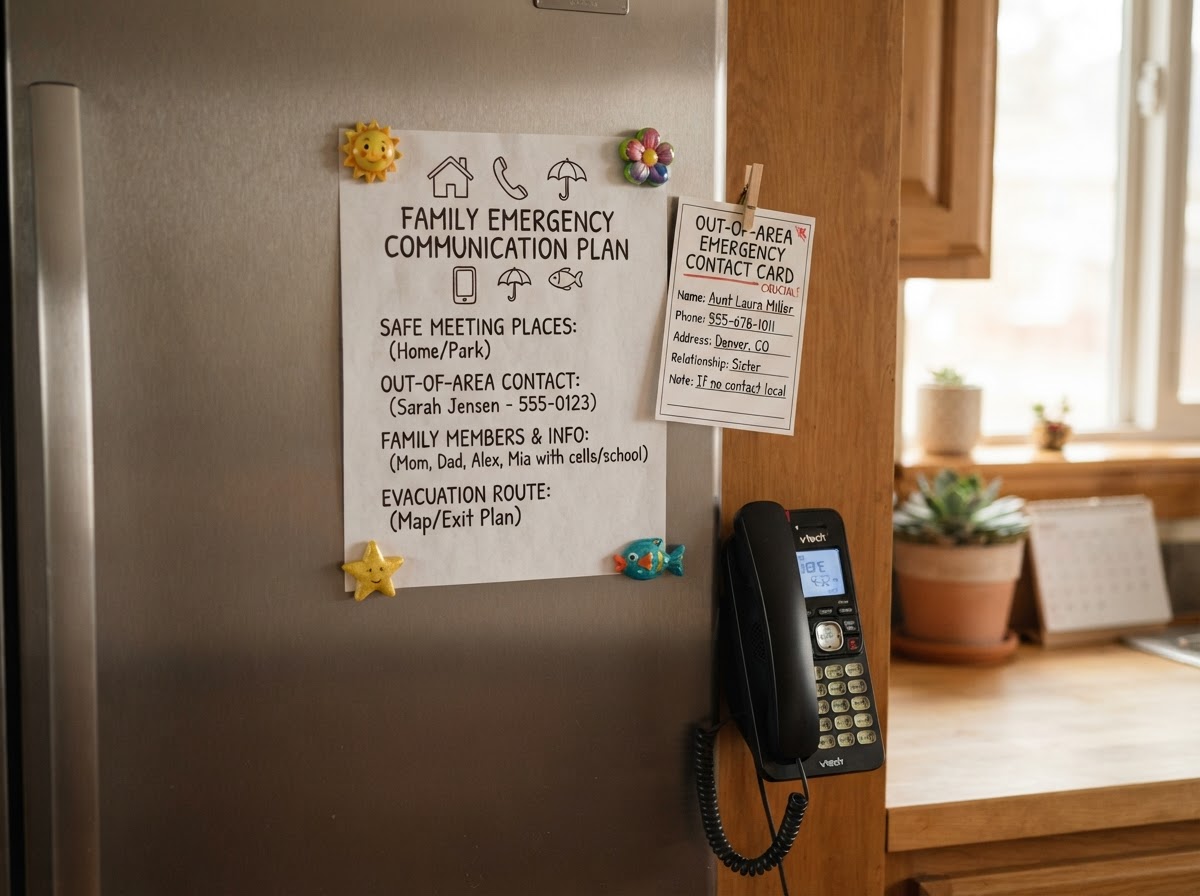
When local lines are jammed, a contact in another region can often relay messages between household members who can reach them but not each other. This is the old, reliable trick from emergency management. Name that person, make sure everyone in the household has their number, and ask the contact if they're willing. Ready.gov recommends this specifically.
The contact doesn't need to do anything elaborate — just answer the phone and pass a message: 'I'm okay, I'm at the school, meeting at the library.' That's it. But it's the thing that reconnects a separated household when the local network is overloaded. The simplicity is the point — a contact who knows to answer and pass messages is the plan.
Choose someone reliable and reachable, not necessarily the closest. A relative two states away who always answers is better than a neighbor who screens calls. Make sure they know they're your contact and what to do. The unprepared contact isn't a plan; the briefed contact is.
Make sure the number is on the contact card, not just in the phone. A dead phone with the contact's number in it is a dead phone with the number you need. The card is the backup; the phone is the primary. Both matter; the card is the one that doesn't fail.
Plan for the contact's own disruption. If the out-of-area contact is also affected — a regional outage that spans their area too — who's the backup? Two contacts in different regions is a better plan than one. The redundancy is what makes the plan hold when the one contact can't be reached.
Know your neighbors
In a disruption, the first help is usually a neighbor, not a first responder — first responders are overwhelmed, and you're right there. Know your neighbors at least by sight, and ideally well enough to ask for or offer help. A block where people know each other shares a generator, checks on the senior at the end of the street, and pools a chainsaw after a storm. A block where they don't is a set of isolated households.
You don't need a formal arrangement. Introduce yourself, exchange numbers, offer to check in during a storm. The mutual aid that works is the informal, pre-existing kind, not the network you try to build during the event. Start before the next risk season. The introduction is the prep; the network is the result.
For a senior or anyone with specific needs on your block, knowing them and checking in is the prep. The 'who checks on the elderly neighbor' question has a better answer when it's a neighbor who already knows them than when it's a stranger or no one. The check-in is a free prep with a high payoff for the block.
Plan the skills on the block. Who has a generator? Who has medical training? Who has a chainsaw or a truck? Knowing the resources before you need them is the community plan. You don't need to inventory everyone's house; you need to know who to ask. The 'who has what' knowledge is the neighborhood resilience.
The honest summary: the family-and-neighbor plan is a household meeting, an out-of-area contact, a contact card, and a neighbor introduction. It's free, it's fast, and it's the prep that makes a disruption survivable instead of isolating. Don't let the household plan be only the supplies — the people around you are the plan that holds when the supplies aren't enough.
Practical priorities
- A household meeting point and out-of-area contact
- Numbers on paper, not just in phones
- An annual rehearsal of the plan
- Neighbors known well enough to ask for help
- Two out-of-area contacts in different regions
Common mistakes
- The plan only in the phone that may die
- No out-of-area contact for a jammed local network
- A plan no one in the household remembers
- Not knowing the neighbors even by sight
- One out-of-area contact with no backup
Your family & neighbor plans checklist
- Household meeting point decided
- Out-of-area contact(s) named and notified
- Contact card printed for each member
- Text-not-call rule agreed
- Annual rehearsal scheduled
- Neighbor introductions and numbers exchanged
Sources & further reading
This is planning guidance, not emergency advice. In an emergency, call 911. See a mistake? Report it.