
🗺️ Plan the basics
Plan how you'll leave and how you'll find each other
Two routes, a meeting point, an offline map, and a reunification plan — decided before the alert, not during.
Evacuation planning is the prep where the decision has to be made fast and the information is incomplete. The plan is: two ways out of the area, a meeting point if you're separated, an offline map for when the cell tower is down, and a reunification contact who can relay messages. It's decided now, calmly, so you don't make it up under a deadline. This page covers the routes, the meeting points, the offline navigation, and the reunification plan that get a household out safely and back together.
Plan two routes and a meeting point
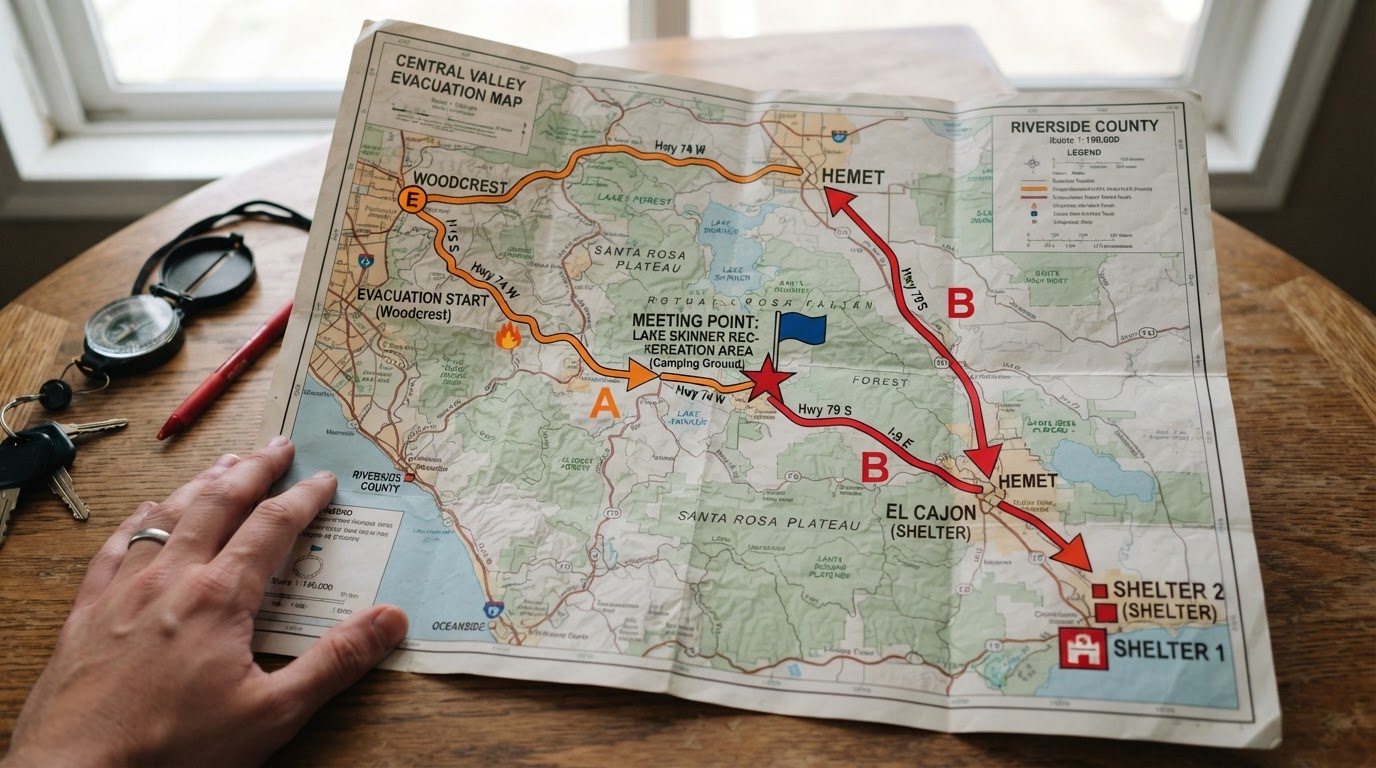
Pick two routes out of your area — a primary and a secondary — because the first one may be closed or jammed. Drive them both once so you know them. Identify a meeting point outside your immediate area where the household regroups if you get separated, and an out-of-area contact who can relay messages when local lines are jammed. The evacuation planner tool captures all of this. Ready.gov's evacuation page is the reference.
Know what you're taking and where it is. The grab-and-go bag, the documents folder, the medications, the phone charger — rehearse grabbing them in under ten minutes. If the evacuation order comes at 2 a.m., you're not packing; you're grabbing. The plan is what makes that possible. The go-bag page covers the full kit; this is the 'get out fast' piece.
Plan for transport. If you drive, keep the gas tank above half during a risk season and know alternate routes that avoid highways. If you don't drive, plan who gives you a ride or what public transit is an option. For anyone with mobility needs, the transport plan is more involved — don't leave it to the moment. The vehicle readiness page covers the car side.
For a household with kids, know the school or daycare's evacuation and release plan. Where do they go? Who's authorized to pick them up? If you can't get to them, who does? Update the authorized list when it changes. The school's plan is part of your plan, not a separate thing. Know it before the evacuation, not at the school door.
Time the grab. Can you be out the door in 10 minutes? 15? If it's longer, what's slowing you down? The timed rehearsal is what turns a written evacuation plan into a working one. A plan you've never timed is a plan that takes 40 minutes when you have 10. The rehearsal is the prep that makes the plan real.
Keep an offline map
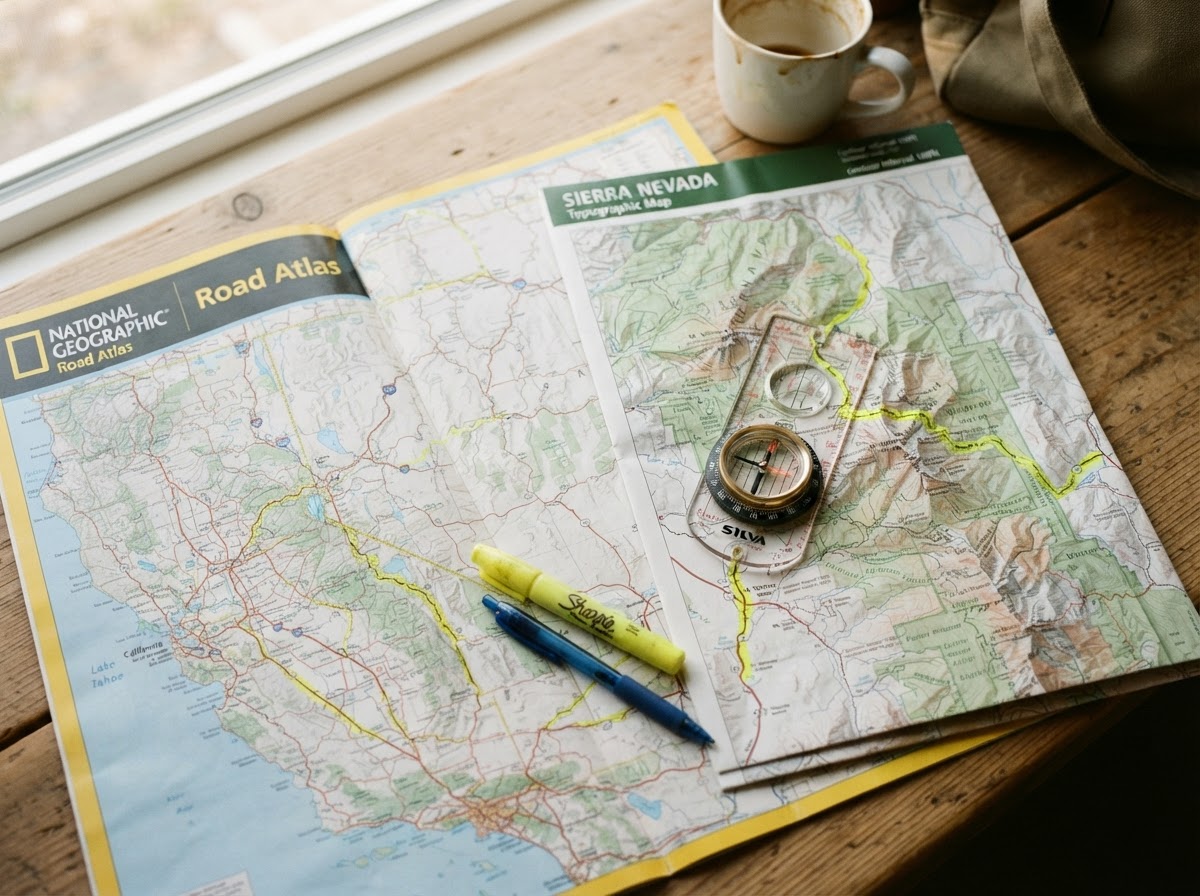
When the cell network is down, your phone's map app isn't loading. Keep a paper map of your region in the car and in your go-bag, with your routes and meeting points marked. Download offline maps in your phone's map app before a risk season — Google Maps and others let you cache an area. A paper map never runs out of battery; a downloaded offline map works when there's no signal.
Mark the route, the meeting point, the out-of-area contact, and the nearest hospital and emergency services. If you have to hand the map to someone else — a teenager, a neighbor helping — they can follow it. A map you understand but no one else does is a weaker plan. The map is a household tool, not a solo one.
For a local evacuation, know the official routes and shelter locations your emergency management publishes. They may differ from the fastest route on a normal day. During an active evacuation, follow the official guidance, not your shortcut. The official routes are managed for traffic flow and hazard; your shortcut may be closed or unsafe. Your county emergency management has this.
Keep a compass if you're in an area where navigation matters — rural, unfamiliar, or off-grid. A phone compass works until the battery dies; a $5 compass always works. For most urban evacuations, the paper map is enough; for rural or outdoor plans, the compass is part of the kit. Match the navigation tools to the terrain.
Update the map when the routes or meeting points change. A map from two years ago with an old meeting point is a map that sends you to the wrong place. The maintenance schedule applies to the map too — check it once a year, update the marks, confirm the routes are still passable. The map is a living tool, not a packed-and-forgotten one.
Plan reunification
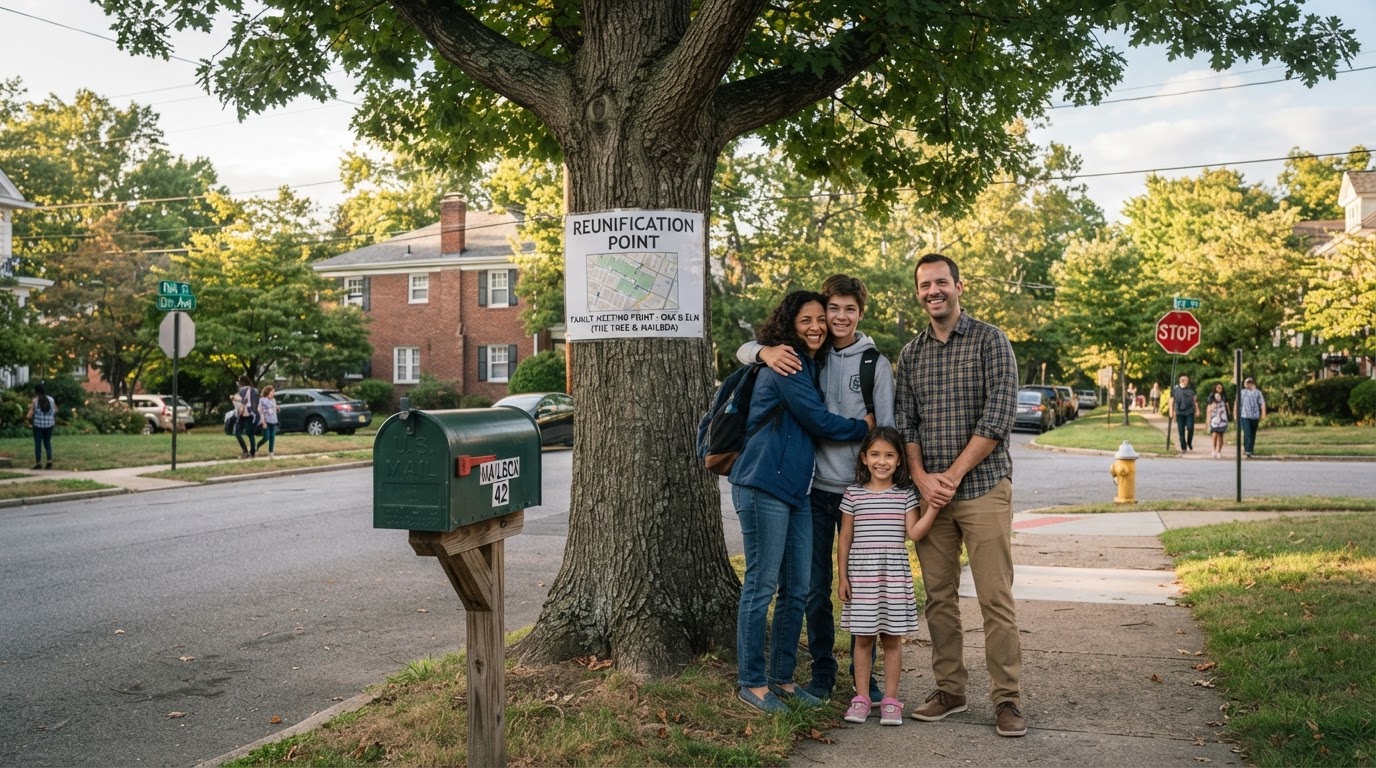
If the household is separated when an event hits — kids at school, a partner at work — the plan is how you reconnect. An out-of-area contact is the old, reliable trick: when local lines are jammed, a contact in another region can relay messages between household members who can reach them but not each other. Name that person and make sure everyone in the household has their number. The communication page covers this in depth.
For kids, know the school or daycare's emergency release plan and who's authorized to pick them up. Update the authorized list when it changes. For a senior or anyone who needs help, plan who checks on them and how. The reunification plan is specific to the people in your household, not a generic template.
Rehearse it. Once a year, walk through: the routes, the meeting point, the grab list, the out-of-area call. A plan on paper that no one's practiced is a weaker plan than one you've run through. The confidence is the point. The rehearsal is what makes the plan hold up under stress — a household that's rehearsed doesn't freeze; one that hasn't does.
Plan for the 'can't get home' scenario. If you're at work and the roads are closed, where do you go? A friend's, a hotel, a shelter? Know the options before you need them. The 'can't get home' plan is the reunification plan from the other direction — not just 'how do the kids get to you' but 'how do you get to the kids.'
The honest summary: the evacuation plan is two routes, a meeting point, an offline map, and an out-of-area contact, rehearsed once a year. It's not exotic, it's not expensive, and it's the prep that matters most when the order comes. The plan on paper is the starting point; the rehearsal is what makes it work. Don't let the evacuation plan be the one you wrote but never practiced.
Practical priorities
- Two routes out, driven once
- A meeting point and an out-of-area contact
- Paper map with routes marked, in the car and go-bag
- Grab list rehearsed in under 10 minutes
- An annual rehearsal of the whole plan
Common mistakes
- Only one route, which is the one that's jammed
- Phone's map app as the only navigation
- No out-of-area contact for a jammed local network
- A grab list you've never timed
- A plan you wrote but never rehearsed
Your navigation & evacuation checklist
- Two evacuation routes identified
- Meeting point and out-of-area contact set
- Paper map in the car and go-bag
- Grab list rehearsed under 10 minutes
- Transport plan for non-drivers or mobility needs
- School/daycare emergency release plan known
- Annual rehearsal scheduled
Sources & further reading
This is planning guidance, not emergency advice. In an emergency, call 911. See a mistake? Report it.